Men often have overlapping concerns. Learn how TRT, ED care, weight loss, labs, and hair restoration may be coordinated at Vital Glow.


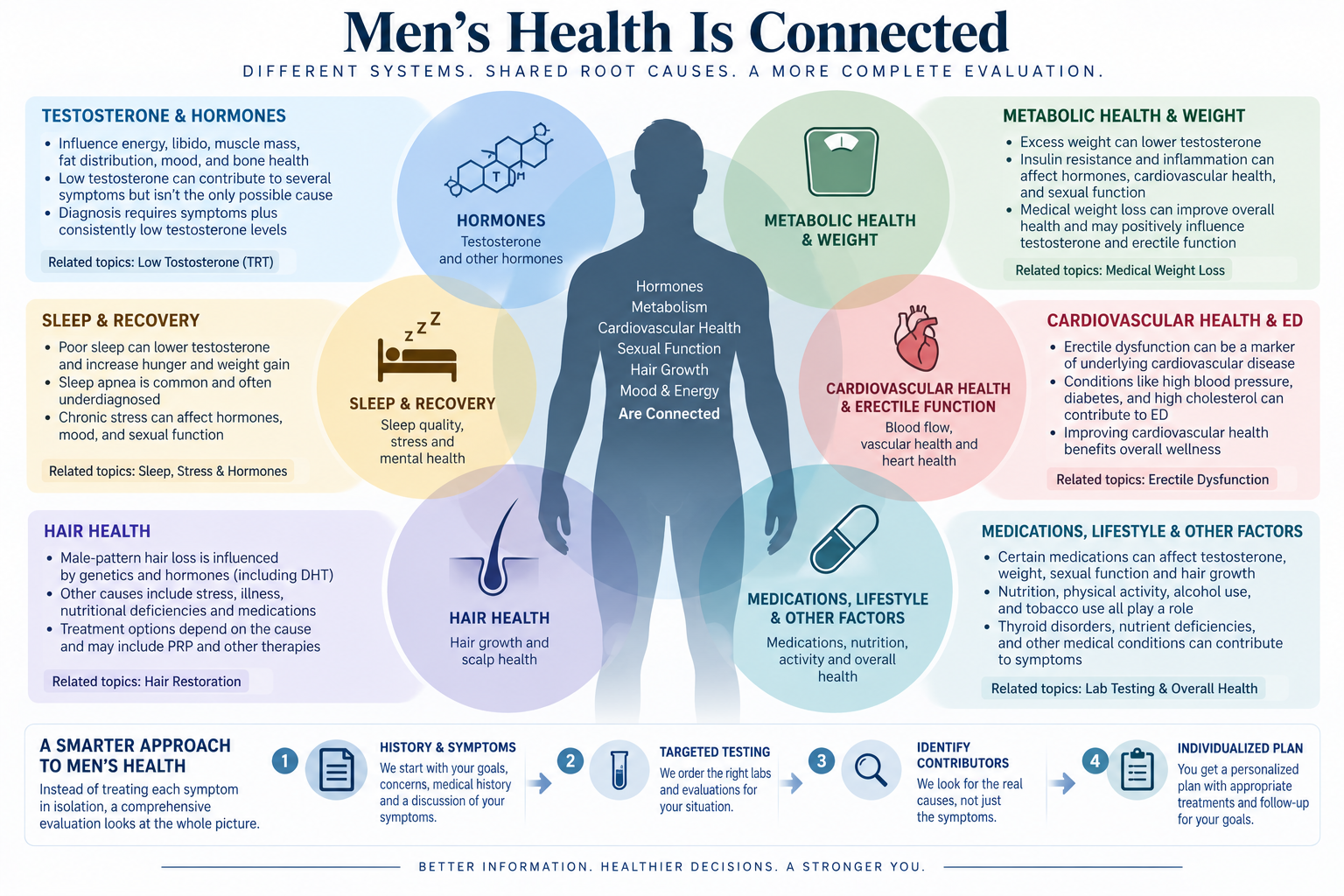
Fatigue, weight gain, low libido, erectile dysfunction, loss of muscle, and hair changes can feel like separate problems. Sometimes they are. But sometimes several of them are connected by the same underlying health factors.
That does not mean every man with these symptoms has low testosterone—or that one treatment will fix everything.
It means that looking at the bigger picture can sometimes make more sense than treating each symptom in isolation.
A coordinated men’s health evaluation can consider symptoms, medical history, medications, sleep, metabolic health, hormone status, sexual health, hair loss patterns, and appropriate laboratory testing to determine which problems may be related and which need their own treatment plan.
Why Can Men’s Health Problems Overlap?
The body does not organize health into separate service categories.
Hormones, cardiovascular health, metabolism, sleep, medications, nutrition, stress, and aging can influence several systems at the same time.
For example, a man might notice:
- Less energy than he used to have
- Increasing abdominal weight
- Difficulty maintaining muscle
- Lower sexual desire
- Erectile dysfunction
- Changes in sleep or mood
- Thinning hair
It can be tempting to assume that one diagnosis—especially low testosterone—explains the entire cluster.
Sometimes testosterone deficiency contributes. But these symptoms are not specific to testosterone deficiency and can also occur with sleep problems, obesity, metabolic disease, thyroid disorders, medication effects, psychological factors, nutritional problems, and other medical conditions.
The goal should therefore be to identify likely contributors before deciding what needs treatment.
Does Low Testosterone Cause Weight Gain, Fatigue, and Low Libido?
Testosterone deficiency can be associated with symptoms including reduced libido, decreased spontaneous erections, reduced muscle mass, and lower energy.
However, symptoms alone cannot diagnose low testosterone.
Current clinical guidance recommends diagnosing hypogonadism when a man has compatible symptoms or signs and consistently low testosterone concentrations measured appropriately.
That distinction matters because fatigue, weight gain, poor concentration, low mood, and reduced motivation are common symptoms with many possible causes.
A testosterone prescription should not substitute for determining why those symptoms are occurring.
Learn more about low testosterone symptoms and when testing may be appropriate →
Can Weight Affect Testosterone?
Yes. The relationship between body weight and testosterone can work in both directions.
Obesity is associated with lower testosterone concentrations in many men. Changes in metabolism, insulin resistance, sleep apnea, inflammation, and hormone signaling may all contribute.
That means a low testosterone result in a man carrying excess weight deserves thoughtful interpretation rather than an automatic assumption that lifelong testosterone replacement is required.
In some men, addressing obesity and related health conditions may improve testosterone levels as well as energy, mobility, cardiovascular risk factors, and overall health.
Where Does Medical Weight Loss Fit?
Medical weight management is not simply another treatment to add because a man has gained a few pounds.
It may be appropriate for men who meet clinical criteria for overweight or obesity and would benefit from structured medical management.
A comprehensive approach can include:
- Medical and weight history
- Review of medications and health conditions
- Nutrition and physical activity
- Sleep and recovery
- Appropriate laboratory evaluation
- Behavioral strategies
- Anti-obesity medication when clinically appropriate
- Ongoing follow-up
Medications such as semaglutide and tirzepatide may be options for appropriately selected patients, but medication is only one component of long-term weight management.
Learn how medical weight loss evaluation and follow-up work →
How Are Erectile Dysfunction and Overall Health Connected?
Erectile dysfunction is another example of a symptom that should not always be viewed in isolation.
An erection depends on adequate blood flow, nerve function, hormonal signaling, psychological factors, and sexual stimulation.
Problems affecting any part of that system can contribute to ED.
Potential contributors can include:
- Cardiovascular disease
- High blood pressure
- Diabetes and metabolic disease
- Obesity
- Low testosterone in some men
- Medication effects
- Neurologic conditions
- Smoking
- Stress, anxiety, or relationship factors
Importantly, erectile dysfunction can also be a marker of underlying cardiovascular disease.
That does not mean every man with ED has heart disease. It does mean that simply treating the erection without considering the man’s broader health can miss useful information.
Learn more about erectile dysfunction, health risks, and treatment options →
Does Treating Low Testosterone Fix Erectile Dysfunction?
Not necessarily.
Testosterone and erectile function are related, but they are not the same thing.
A man with confirmed testosterone deficiency may experience sexual symptoms related to that deficiency. Another man may have normal testosterone but ED related primarily to vascular disease, diabetes, medications, psychological factors, or another cause.
Some men may have more than one contributor.
This is why ED and testosterone evaluation can overlap without assuming that testosterone therapy is the treatment for every case of erectile dysfunction.
Where Does Hair Loss Fit Into Men’s Health?
Hair loss can be even more confusing because men frequently associate changes in hair with testosterone.
The most common form of hair loss in men is androgenetic alopecia, commonly called male-pattern hair loss.
It involves genetic susceptibility and androgen signaling, particularly the effects of dihydrotestosterone, or DHT, on susceptible hair follicles.
But not every case of thinning hair is male-pattern hair loss.
Hair shedding or thinning can also be influenced by:
- Illness
- Major physical or emotional stress
- Rapid weight loss
- Nutritional deficiencies
- Thyroid disorders
- Medications
- Scalp conditions
- Other forms of alopecia
This becomes especially relevant when someone is simultaneously changing medications, losing substantial weight, beginning hormone treatment, or experiencing other health changes.
Learn more about evaluating hair loss and PRP hair restoration →
Should Hair Loss Automatically Be Treated With PRP?
No.
PRP hair restoration may be considered for appropriately selected patients, particularly for certain forms of pattern hair loss, but treatment selection should begin with identifying the likely type of hair loss.
A man experiencing sudden diffuse shedding after major weight loss, for example, may need a different evaluation than a man with slowly progressing recession and thinning at the crown.
The treatment should follow the diagnosis—not the other way around.
Why Are Labs Useful in Men’s Health?
Laboratory testing can help answer specific clinical questions that symptoms alone cannot answer.
Depending on the man’s symptoms and history, testing may help evaluate areas such as:
- Testosterone status
- Thyroid function
- Blood glucose and metabolic health
- Cholesterol and cardiovascular risk
- Blood counts
- Selected nutritional deficiencies
- Other suspected medical contributors
But more testing is not automatically better.
A useful laboratory evaluation is targeted to the clinical question rather than simply ordering the largest available panel.
For example, the appropriate evaluation for unexplained fatigue may differ from the evaluation for erectile dysfunction, hair shedding, or suspected testosterone deficiency.
Learn why targeted laboratory testing matters in hormone and wellness care →
How Is Low Testosterone Properly Diagnosed?
Low testosterone should not be diagnosed from symptoms alone or from a single poorly timed laboratory result.
Current Endocrine Society guidance recommends confirming suspected hypogonadism with symptoms or signs consistent with testosterone deficiency plus consistently low testosterone concentrations.
Testing generally includes at least two separate early-morning testosterone measurements using accurate testing methods.
Additional evaluation may be needed to determine why testosterone is low.
That distinction is important because finding the underlying cause can affect treatment decisions.
Does a Low Testosterone Result Automatically Mean TRT?
No.
A low laboratory value needs to be interpreted in context.
Clinicians may need to consider factors such as:
- Symptoms
- Repeat testosterone measurements
- Timing and quality of testing
- Obesity
- Sleep disorders
- Medications
- Acute or chronic illness
- Pituitary or testicular causes
- Fertility goals
- Potential treatment risks
For men with confirmed symptomatic hypogonadism who are appropriate candidates, testosterone replacement therapy may be considered after discussing expected benefits, limitations, risks, and monitoring.
What Does TRT Monitoring Involve?
Starting testosterone therapy is not the end of the evaluation.
Men receiving TRT require follow-up to assess treatment response and monitor for potential adverse effects.
Depending on the individual and treatment plan, follow-up can include assessment of:
- Symptoms and treatment response
- Testosterone concentrations
- Hematocrit
- Potential adverse effects
- Prostate health when appropriate
- Changes in medical history
The goal is not simply to drive testosterone to the highest possible number. Treatment should address confirmed deficiency while balancing benefits, risks, and the patient’s overall health.
What About Fertility and TRT?
Fertility goals should be discussed before starting testosterone therapy.
External testosterone can suppress the hormonal signals needed for sperm production and may significantly reduce fertility.
For that reason, testosterone therapy is generally not recommended for men who are planning fertility in the near term.
This is another reason a men’s health consultation should consider future goals rather than focusing exclusively on today’s testosterone result.
Why Can Coordinated Care Be Useful?
Consider a man who presents with weight gain, fatigue, lower libido, erectile dysfunction, and thinning hair.
Those symptoms could potentially lead to five separate treatments.
But first, it may be more useful to ask:
- How well is he sleeping?
- Has his weight changed recently?
- Does he have cardiovascular or metabolic risk factors?
- What medications is he taking?
- Is testosterone actually low?
- If it is low, why?
- Is ED primarily hormonal, vascular, medication-related, psychological, or multifactorial?
- What pattern of hair loss is occurring?
- Could rapid weight loss or nutritional changes affect his hair?
The answers may reveal that some problems are connected while others are independent.
That is the advantage of coordinated evaluation: not more treatment, but a clearer reason for each treatment that is recommended.
Does Every Problem Need to Be Treated at the Same Time?
No.
In some cases, treating one underlying issue may improve several symptoms.
In others, multiple problems require separate treatments.
There may also be reasons to address issues in a particular order.
For example, significant untreated sleep apnea, uncontrolled metabolic disease, medication effects, or another medical condition may deserve attention while hormone symptoms are being evaluated.
Likewise, rapid weight loss may influence hair shedding, making the timing and cause of hair changes important before choosing a hair-restoration treatment.
A coordinated plan should prioritize problems based on medical importance, symptoms, goals, and what the evaluation actually shows.
What Should a Comprehensive Men’s Health Evaluation Accomplish?
A useful men’s health evaluation should help answer four questions:
- What symptoms or health changes are occurring?
- What are the most likely contributing factors?
- What testing or further evaluation is actually useful?
- Which treatments are appropriate—and which are not needed?
That approach is different from assuming that fatigue means testosterone, weight gain means a GLP-1 medication, ED means an ED prescription, or thinning hair means PRP.
Sometimes those treatments may be appropriate.
The evaluation is what determines whether they make sense for the individual patient.
Integrated Men’s Health Care in Columbia, SC
Vital Glow provides men’s health evaluations in Columbia, South Carolina, with services that can address several areas of men’s health when clinically appropriate, including testosterone evaluation and TRT, medical weight management, erectile dysfunction care, laboratory testing, and hair restoration.
Having these services available in one practice can make it easier to look for connections between symptoms while still treating each problem according to its own cause.
The goal is not to put every man on multiple treatments. It is to build an individualized plan based on symptoms, medical history, appropriate testing, health risks, and personal goals.
Frequently Asked Questions
Can low testosterone cause weight gain and erectile dysfunction?
Testosterone deficiency can contribute to changes in body composition, libido, and sexual function in some men, but weight gain and ED have many possible causes. Low testosterone should be confirmed with appropriate testing rather than diagnosed from symptoms alone.
Can losing weight increase testosterone?
Obesity is associated with lower testosterone concentrations in many men, and meaningful weight loss can improve testosterone levels in some cases. Whether that eliminates the need for other treatment depends on the individual and the cause of the testosterone deficiency.
Does TRT help with weight loss?
TRT is a treatment for appropriately diagnosed testosterone deficiency, not a general weight-loss medication. Men who meet clinical criteria for medical weight management may require a separate weight-management strategy.
Does low testosterone always cause ED?
No. Erectile dysfunction can result from vascular disease, diabetes, medications, neurologic problems, psychological factors, low testosterone, or a combination of causes. Some men with ED have normal testosterone levels.
Can weight-loss treatment cause hair shedding?
Rapid or substantial weight loss can sometimes trigger temporary diffuse hair shedding, particularly when accompanied by physiologic stress or inadequate nutrition. That is different from classic male-pattern hair loss and may require a different approach.
Should I have my testosterone checked if I have ED?
Testosterone testing can be an appropriate part of an ED evaluation. The American Urological Association recommends measuring morning total testosterone in men presenting with erectile dysfunction.
Can I receive TRT, medical weight loss treatment, and ED treatment at the same time?
Potentially, but each treatment should have its own clinical indication. The fact that several treatments are available does not mean they are all appropriate for every patient. Medical history, medications, testing, risks, and treatment goals should be considered together.
Why evaluate these problems together?
Because fatigue, weight changes, sexual symptoms, metabolic health, hormone status, sleep, and other health factors can overlap. Looking at the whole picture can help identify which problems may share an underlying contributor and which require separate treatment.
Medically reviewed by Candace Danbury, MSN, APRN, FNP-BC.