Learn common signs of low testosterone and how Vital Glow evaluates energy, libido, strength, mood, labs, and TRT options.


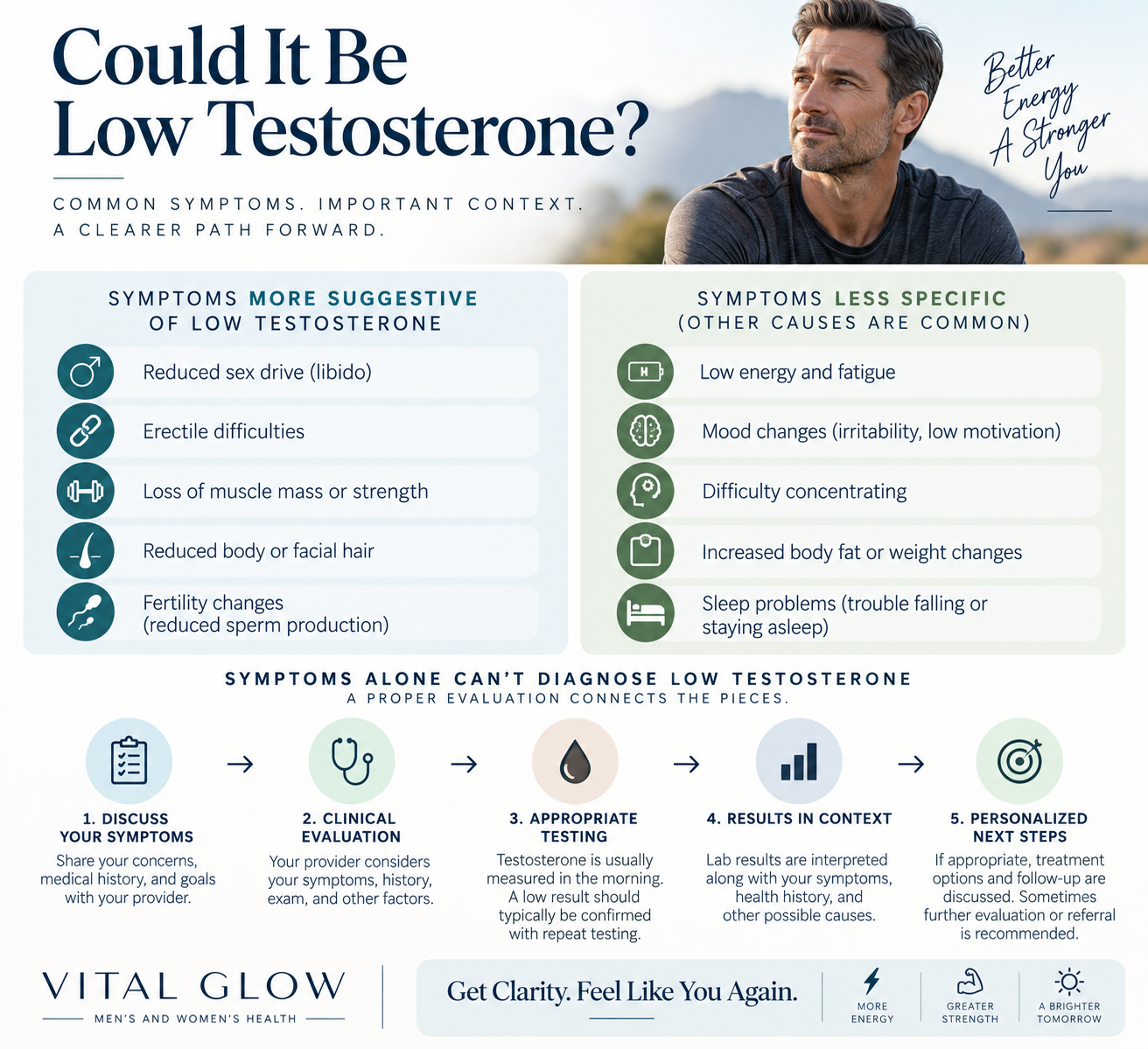
Low testosterone can affect libido, sexual function, muscle mass, body composition, energy, mood, and other aspects of men’s health—but symptoms alone cannot tell you whether your testosterone is actually low.
Many of the symptoms associated with testosterone deficiency are common and can have other causes. Fatigue, reduced motivation, weight gain, erectile difficulties, poor sleep, and changes in mood, for example, can occur for reasons that have little or nothing to do with testosterone.
That is why a proper evaluation combines your symptoms and health history with appropriately performed laboratory testing rather than diagnosing “Low T” based on how you feel.
What Are the Symptoms of Low Testosterone in Men?
Testosterone affects several systems in the male body, so testosterone deficiency can present in different ways.
Possible signs and symptoms can include:
- Reduced sex drive
- Erectile difficulties
- Loss of spontaneous erections
- Reduced muscle mass or strength
- Increased body fat
- Low energy
- Mood changes
- Difficulty concentrating
- Reduced body or facial hair
- Breast enlargement or tenderness
- Reduced sperm production or infertility
- Loss of bone density
MedlinePlus lists symptoms including reduced sex drive, erectile problems, decreased muscle size and strength, increased body fat, depression, difficulty concentrating, sleep problems, and bone loss among possible manifestations of low testosterone.
Importantly, not every man with testosterone deficiency experiences the same symptoms, and having one or several of these symptoms does not establish that testosterone is the cause.
Which Low-Testosterone Symptoms Are Most Specific?
Some symptoms raise more suspicion for testosterone deficiency than others.
Sexual and reproductive changes—such as reduced libido, erectile difficulties, reduced spontaneous erections, or infertility—can be important clues. Changes in muscle mass, body composition, body hair, breast tissue, red blood cell production, and bone health can also occur.
Symptoms such as fatigue, poor concentration, low motivation, sleep problems, and mood changes matter too, but they are much less specific.
A man who feels exhausted every afternoon should not automatically assume he has low testosterone. The symptom is real, but testosterone is only one possible explanation.
Can Low Testosterone Cause Fatigue and Low Energy?
Low energy can occur with testosterone deficiency, but fatigue is one of the easiest symptoms to misattribute to hormones.
Fatigue may also be associated with sleep problems, medications, thyroid disorders, anemia, nutritional issues, chronic illness, stress, depression, metabolic conditions, and other causes.
That means the useful question is not simply:
“Am I tired?”
It is:
“Why am I tired, and is testosterone actually part of the explanation?”
Laboratory testing and a broader health evaluation can help answer that question.
Can Low Testosterone Affect Libido?
Yes. Reduced sexual desire is one of the recognized symptoms associated with testosterone deficiency.
But libido is influenced by much more than one hormone.
Relationships, stress, sleep, medications, mental health, other medical conditions, sexual function, and overall health can all affect sexual desire.
A change in libido therefore deserves context rather than an automatic assumption that testosterone replacement is the answer.
Can Low Testosterone Cause Erectile Dysfunction?
Testosterone can contribute to sexual function, and erectile dysfunction can occur in men with testosterone deficiency.
However, ED is not synonymous with Low T.
Erections depend heavily on vascular, neurologic, hormonal, psychological, and medication-related factors. Diabetes, cardiovascular disease, high blood pressure, medication effects, stress, and other conditions may contribute.
That is why erectile dysfunction can sometimes be an important reason to look beyond testosterone alone.
If ED is your primary concern, read more about erectile dysfunction evaluation and treatment at Vital Glow.
Can Low Testosterone Affect Muscle and Strength?
Testosterone plays a role in maintaining muscle mass and strength.
Men with testosterone deficiency may notice changes in muscle mass, strength, or body composition. Some may also experience an increase in body fat.
But those changes are also influenced by physical activity, nutrition, calorie intake, sleep, aging, illness, medications, and changes in body weight.
Difficulty gaining muscle is therefore not, by itself, a diagnosis of testosterone deficiency.
Can Low Testosterone Affect Mood and Concentration?
Mood changes and difficulty concentrating can occur in men with low testosterone, but these symptoms are particularly nonspecific.
The Endocrine Society emphasized in its 2026 statement on testosterone replacement therapy that symptoms such as changes in energy, libido, and mood can have multiple causes and that symptoms alone do not establish hypogonadism.
That distinction is important because treating a testosterone number will not necessarily correct symptoms caused primarily by something else.
What Causes Low Testosterone?
Low testosterone is not one single condition with one single cause.
The problem can originate in the testicles themselves or in the hormonal signals from the hypothalamus and pituitary gland that tell the testicles to produce testosterone.
Medical conditions, medications, obesity, testicular injury or disease, pituitary or hypothalamic disorders, and other factors can contribute to low testosterone. Testosterone levels also tend to decline with age.
MedlinePlus describes multiple potential causes of male hypogonadism, including certain medications, testicular disease or injury, obesity, genetic conditions, and disorders affecting hormone production.
Determining that testosterone is low is therefore only part of the evaluation. In some men, understanding why it is low is also important.
How Is Low Testosterone Diagnosed?
This is where the distinction between symptoms and diagnosis becomes especially important.
The Society recommends confirming the diagnosis by repeating a morning fasting total testosterone measurement.
Its 2026 statement further emphasizes that an accurate diagnosis should be based on at least two early-morning fasting testosterone tests using reliable laboratory testing.
In other words:
Symptoms + appropriate testing + clinical evaluation matter more than either symptoms or one testosterone result by itself.
Why Is Testosterone Usually Tested in the Morning?
Testosterone concentrations vary over the course of the day.
For that reason, early-morning testing is commonly used when evaluating suspected testosterone deficiency, and an initially low result should generally be confirmed rather than immediately treated as a definitive diagnosis.
Testing quality matters too. The Endocrine Society has noted that differences among testosterone assays can contribute to inconsistent results, which is another reason laboratory values need appropriate interpretation.
What Other Tests Might Be Needed?
The answer depends on your symptoms, testosterone results, medical history, medications, age, and other findings.
If testosterone deficiency is confirmed, additional testing may sometimes help distinguish whether the problem originates primarily in the testicles or in the hormonal signaling system involving the pituitary and hypothalamus.
The Endocrine Society recommends measuring luteinizing hormone (LH) and follicle-stimulating hormone (FSH) in men with hypogonadism to help distinguish primary from secondary causes.
Other laboratory evaluation may be appropriate depending on the individual.
This is one reason Vital Glow uses laboratory testing as part of a broader evaluation rather than looking at testosterone as an isolated number.
Does a Low Testosterone Result Automatically Mean You Need TRT?
No.
A laboratory result needs to be considered alongside symptoms, repeat testing when appropriate, possible causes, health history, treatment goals, potential risks, and contraindications.
There are also situations in which testosterone therapy may not be appropriate.
For example, testosterone therapy can suppress sperm production. The Endocrine Society recommends against starting testosterone therapy in men who are planning fertility in the near term.
Other health factors can also affect whether treatment is appropriate and what monitoring is needed.
What Should You Know About TRT Safety?
Testosterone replacement therapy is a medical treatment and should include appropriate evaluation and follow-up.
Safety information has also evolved as new evidence has become available.
In 2025, the U.S. Food and Drug Administration removed its boxed-warning language about increased cardiovascular outcomes after reviewing results from the large TRAVERSE cardiovascular safety trial. However, ambulatory blood-pressure studies found increases in blood pressure across testosterone products, leading the FDA to require blood-pressure warnings.
In 2026, the FDA announced additional updates to testosterone-product labeling following further review of the evidence.
The practical takeaway is not that testosterone is universally “safe” or “dangerous.” It is that treatment decisions should be individualized, and appropriate monitoring remains part of care.
When Should You Consider Getting Your Testosterone Checked?
Testing may be reasonable when you have symptoms or clinical findings that could be consistent with testosterone deficiency—particularly when those symptoms are persistent or affecting your quality of life.
Examples might include a meaningful change in libido, erectile difficulties, unexplained loss of muscle mass, fertility concerns, or a combination of symptoms that warrants further evaluation.
Routine testosterone screening of every man without symptoms is different. The Endocrine Society does not recommend population-wide screening for hypogonadism in asymptomatic men.
What Happens If Your Testosterone Is Normal?
A normal testosterone result does not mean your symptoms are imaginary or unimportant.
It means testosterone may not provide the explanation.
Depending on your symptoms and health history, your provider may need to consider other possible contributors rather than attempting to increase a testosterone value that is not actually deficient.
That is an important benefit of approaching men’s health as an evaluation rather than beginning with a predetermined treatment.
Low Testosterone Evaluation in Columbia, SC
At Vital Glow, testosterone evaluation begins with your symptoms, health history, goals, and appropriate laboratory testing.
If testing and clinical evaluation support testosterone deficiency and treatment is appropriate, a personalized treatment and monitoring plan can then be discussed.
If testosterone does not appear to explain what you’re experiencing, the next step may be evaluating other possible contributors or recommending appropriate follow-up elsewhere.
Vital Glow provides men’s health services for patients in Columbia and surrounding Midlands communities.
Learn more about testosterone evaluation and TRT at Vital Glow →
Frequently Asked Questions About Low Testosterone
What are the most common signs of low testosterone?
Possible symptoms include reduced libido, erectile difficulties, loss of muscle mass or strength, increased body fat, low energy, mood changes, difficulty concentrating, reduced body hair, infertility, and changes in bone health. These symptoms can have other causes, so they do not diagnose low testosterone by themselves.
What testosterone level is considered low?
There is not one number that should be interpreted independently of the patient, laboratory method, symptoms, and clinical circumstances. Current guidance emphasizes consistently low, accurately measured testosterone together with compatible symptoms rather than diagnosing testosterone deficiency from one isolated result.
Can you have symptoms of low testosterone with a normal testosterone level?
Yes. Many symptoms associated with Low T are nonspecific and can result from other health, medication, sleep, psychological, metabolic, or lifestyle factors. A normal result may be a reason to investigate other explanations.
Can low testosterone cause erectile dysfunction?
Testosterone deficiency can contribute to erectile difficulties, but ED can also involve vascular disease, diabetes, medications, neurologic factors, stress, and other causes. Testosterone is only one part of an ED evaluation.
Can low testosterone make it harder to build muscle?
Testosterone plays an important role in muscle mass and strength, and testosterone deficiency can contribute to changes in both. Exercise, nutrition, sleep, aging, illness, and other factors also affect muscle development.
Do I need more than one testosterone test?
When an initial result is low and testosterone deficiency is suspected, current Endocrine Society guidance recommends confirmation with repeat early-morning testing rather than making the diagnosis from a single measurement.
Does TRT affect fertility?
Yes. External testosterone can suppress the hormonal signals required for sperm production. Men who want to preserve or pursue fertility should discuss that goal with their healthcare provider before starting testosterone therapy.
Medically reviewed by Candace Danbury, MSN, APRN, FNP-BC.