Learn why medical weight loss should include consultation, labs when appropriate, realistic goals, follow-up, and personalized support.


Medical weight loss is more than getting a prescription for a weight-loss medication. A well-designed program starts by understanding your health, weight history, medications, goals, and potential barriers to weight loss—and then determining which treatment options may be appropriate for you.
For some people, that plan may include a prescription weight-management medication such as a GLP-1 or GIP/GLP-1 medication. For others, a different medication or a non-medication approach may make more sense.
The goal should not simply be to make the number on the scale move as quickly as possible. Medical weight management should help you lose weight safely, preserve your health and function, manage side effects, and develop a plan for maintaining your progress over time.
What Is Medical Weight Loss?
Medical weight loss is weight management provided with the involvement of a healthcare professional.
Unlike a commercial diet or a one-size-fits-all program, medical weight management can take your health history, medications, weight-related conditions, previous weight-loss attempts, and other individual factors into account.
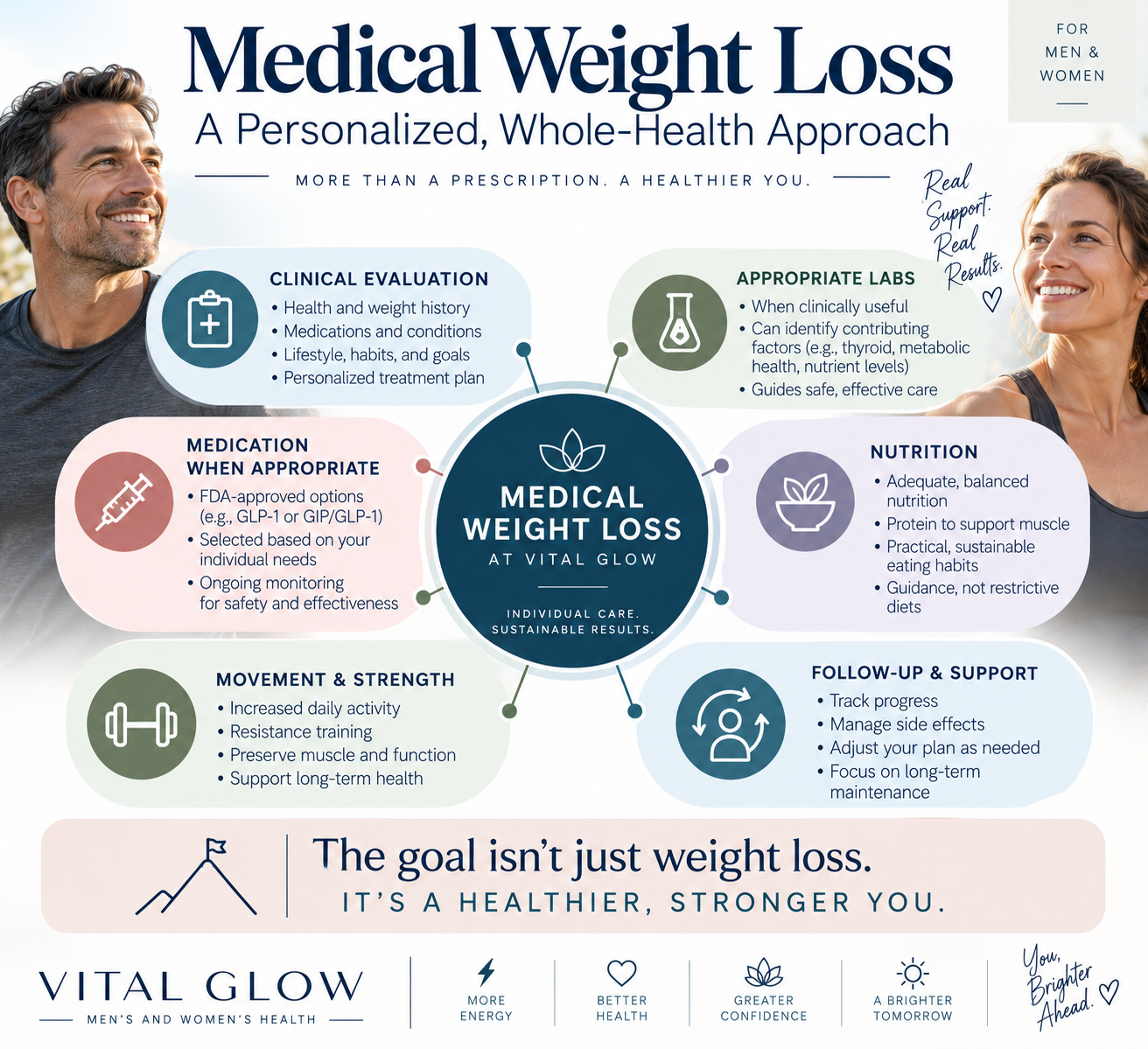
A medical weight-loss plan may include:
- Review of your medical and weight history
- Review of prescription medications and supplements
- Assessment of eating, activity, sleep, and other relevant habits
- Laboratory testing when clinically appropriate
- Nutrition and physical-activity recommendations
- Prescription weight-management medication when appropriate
- Monitoring for effectiveness and side effects
- Adjustments to the treatment plan over time
- Referral for additional care when another treatment or specialist is appropriate
The appropriate plan will not look exactly the same for every patient.
How Is Medical Weight Loss Different From Dieting on Your Own?
Many people who seek medical weight management have already tried to lose weight on their own.
They may have counted calories, followed structured diets, increased exercise, used apps, tried intermittent fasting, or repeatedly lost and regained weight.
Medical weight management does not make nutrition or physical activity irrelevant. Instead, it adds clinical evaluation and additional treatment options when appropriate.
The National Institute of Diabetes and Digestive and Kidney Diseases explains that treatment for overweight and obesity commonly includes lifestyle changes and may also include prescription medication or metabolic and bariatric surgery depending on the individual.
Who Might Be a Candidate for Prescription Weight-Loss Medication?
Prescription weight-management medications are not intended for everyone who wants to lose a few pounds.
For adults, healthcare professionals commonly consider weight-management medication for people with:
- A body mass index (BMI) of 30 or greater, or
- A BMI of 27 or greater along with a weight-related health condition
Those are general treatment criteria, not an automatic prescription.
A provider still needs to consider your health history, medications, possible contraindications, treatment goals, potential benefits, possible side effects, and other individual factors.
BMI also has limitations. It is a screening measurement based on height and weight, not a complete measurement of someone’s health or body composition.
What Are GLP-1 Weight-Loss Medications?
GLP-1 medications have received considerable attention because they can reduce appetite and help some people achieve substantial weight loss.
GLP-1 stands for glucagon-like peptide-1, a naturally occurring hormone involved in appetite and other metabolic processes.
Semaglutide is one example. Wegovy® is an FDA-approved form of semaglutide used for chronic weight management in appropriate patients.
Tirzepatide works somewhat differently because it acts on both GIP (glucose-dependent insulinotropic polypeptide) and GLP-1 pathways. Zepbound® is an FDA-approved form of tirzepatide for chronic weight management in appropriate patients.
These medications can help reduce hunger and increase feelings of fullness, making it easier for some people to maintain the reduced calorie intake necessary for weight loss.
They are tools—not substitutes for every other aspect of weight management.
Is Ozempic the Same as Wegovy?
Ozempic® and Wegovy® both contain semaglutide, but they are FDA-approved and labeled for different indications and dosing regimens.
Wegovy is approved for chronic weight management in appropriate patients, while Ozempic is approved for specific uses involving type 2 diabetes and associated health risks.
Likewise, Mounjaro® and Zepbound® both contain tirzepatide but are marketed and approved for different indications.
This is one reason it is more accurate to discuss the actual medication and its intended use rather than using brand names interchangeably.
How Much Weight Can You Lose With Weight-Loss Medication?
There is no single amount of weight that everyone should expect to lose.
Results vary substantially based on the medication, dose, duration of treatment, individual response, nutrition, activity, adherence, health conditions, and other factors.
Some modern weight-management medications have produced substantial average weight loss in clinical trials, but an average is not a promise of an individual’s result.
A better treatment conversation focuses on your progress, health, side effects, body composition and function, and whether the treatment continues to provide an appropriate benefit for you.
Why Does Nutrition Still Matter When You’re Taking a GLP-1?
A medication can reduce appetite, but it does not automatically determine what you eat.
When appetite drops substantially, the quality of the food you do eat becomes especially important.
A weight-loss plan should provide adequate nutrition while supporting a calorie intake consistent with your goals.
Protein intake may also deserve particular attention during weight loss because losing weight generally involves losing some lean tissue as well as body fat.
The goal should not be to eat as little as physically possible simply because a medication makes that possible.
Why Does Strength Training Matter During Weight Loss?
Preserving muscle matters during weight loss.
Muscle contributes to strength, mobility, physical function, and long-term health. When body weight decreases, some loss of lean tissue can occur along with fat loss.
Resistance training can be an important part of a weight-management plan because it provides a stimulus for maintaining muscle and strength.
The appropriate activity program depends on your current fitness, health conditions, physical limitations, and starting point.
For someone who has not exercised regularly, the first goal may simply be increasing daily movement and gradually introducing resistance exercise rather than beginning an aggressive workout program.
Do You Need Lab Work Before Starting Medical Weight Loss?
Not every patient needs exactly the same laboratory panel.
Laboratory testing should be selected based on your medical history, symptoms, medications, health risks, and the treatment being considered.
Depending on the individual, testing may provide useful information about metabolic health or other conditions relevant to treatment.
Labs can also help establish baseline information that may be useful during follow-up.
But laboratory testing should answer a clinical question rather than simply generating the largest possible panel.
For a deeper explanation, read why comprehensive lab testing can be useful before hormone and wellness care.
Can Hormones or Medical Conditions Make Weight Loss Harder?
Sometimes, but weight is rarely explained by one hormone or laboratory result.
Body weight is influenced by a complicated interaction among calorie intake, physical activity, genetics, medications, sleep, environment, health conditions, appetite regulation, and other biological and behavioral factors.
Certain medications can contribute to weight gain, and some medical conditions can affect weight or symptoms associated with weight changes.
That is why a medical evaluation can be useful when weight changes are unexpected, accompanied by other symptoms, or unusually difficult to explain.
It is also why claims that one hormone imbalance is responsible for virtually everyone’s difficulty losing weight should be viewed cautiously.
What Side Effects Can GLP-1 and GIP/GLP-1 Medications Cause?
Side effects vary by medication and by patient.
Gastrointestinal symptoms are common with medications such as semaglutide and tirzepatide. Depending on the medication, these may include:
- Nausea
- Vomiting
- Diarrhea
- Constipation
- Abdominal discomfort
More serious adverse effects can also occur.
That is one reason treatment should include discussion of the medication’s risks, contraindications, interactions, and symptoms that should prompt medical attention.
Patients should receive instructions specific to the medication they are prescribed rather than relying solely on general information found online.
Why Are GLP-1 Doses Usually Increased Gradually?
Weight-management medications such as semaglutide and tirzepatide are generally started at lower doses and increased according to an established dosing schedule when appropriate.
This gradual approach helps the body adjust to the medication and can help manage gastrointestinal side effects.
The goal is not necessarily to reach the highest possible dose as quickly as possible.
How a patient is responding and tolerating treatment matters.
Why Does Follow-Up Matter During Medical Weight Loss?
A prescription should not be the end of medical weight management.
Follow-up gives the patient and provider an opportunity to evaluate:
- Weight and body-composition changes
- Hunger and appetite
- Medication tolerance
- Side effects
- Nutrition and hydration
- Physical activity and strength
- Changes in health or other medications
- Whether the current treatment still makes sense
Depending on the treatment and the patient’s health, follow-up laboratory monitoring may also be appropriate.
If a medication is not producing adequate benefit, is causing unacceptable side effects, or is no longer appropriate, the treatment plan may need to change.
What Happens When You Stop a Weight-Loss Medication?
Weight regain can occur after weight-management medication is discontinued.
That does not necessarily mean the medication “failed.”
Obesity is a chronic condition, and medications used for chronic weight management may need to be continued long term when they remain effective, appropriate, and well tolerated.
The National Institute of Diabetes and Digestive and Kidney Diseases notes that some weight may be regained after stopping weight-management medication.
This makes long-term planning important from the beginning.
Before starting treatment, it is reasonable to discuss not only how you plan to lose weight, but also how you will approach maintenance and what may happen if medication is eventually discontinued.
Is Faster Weight Loss Always Better?
No.
The scale is only one measurement of progress.
An approach that produces rapid weight loss but leaves someone poorly nourished, dehydrated, losing excessive muscle, unable to tolerate treatment, or unable to maintain the result is not necessarily a better plan.
Progress may also be reflected in:
- Waist circumference or body composition
- Improved mobility or physical function
- Better blood pressure or metabolic measurements
- Improved fitness
- Greater strength
- Better eating habits
- Improvement in weight-related health conditions
Individual goals should be discussed with your healthcare provider.
What Should You Ask Before Starting a Medical Weight-Loss Program?
Before enrolling in a program, consider asking:
- Who will evaluate me and prescribe my medication?
- Which medication are you recommending, and why?
- Is the medication FDA-approved for weight management?
- What side effects and risks should I know about?
- What should I do if I experience side effects?
- How often will I have follow-up appointments?
- Will I receive guidance about nutrition and physical activity?
- How will we monitor whether the treatment is working?
- What is the plan for preserving muscle during weight loss?
- What happens when I reach my goal weight?
- What is included in the program price?
A medical weight-loss program should be able to answer those questions clearly.
Medical Weight Loss in Columbia, SC
At Vital Glow, medical weight management begins with understanding the individual rather than starting everyone with an identical plan.
Your evaluation can include your health and weight history, previous weight-loss efforts, medications, symptoms, goals, and laboratory testing when clinically useful.
When prescription weight-management medication is appropriate, treatment includes ongoing follow-up so that progress, medication tolerance, side effects, and the overall plan can be reassessed over time.
Vital Glow provides medical weight-management services for patients in Columbia and surrounding Midlands communities.
Learn more about medical weight loss at Vital Glow →
Frequently Asked Questions About Medical Weight Loss
What is medical weight loss?
Medical weight loss is weight management provided with the involvement of a healthcare professional. Depending on the patient, it may include clinical evaluation, lifestyle changes, laboratory testing, prescription medication, monitoring, and ongoing adjustments to the treatment plan.
Do I have to take a GLP-1 medication for medical weight loss?
No. GLP-1 medications are one treatment option. Whether medication is appropriate—and which medication is appropriate—depends on your health, weight-related risks, treatment goals, medical history, medications, potential contraindications, and other factors.
What is the difference between semaglutide and tirzepatide?
Semaglutide acts on the GLP-1 pathway, while tirzepatide acts on both GIP and GLP-1 pathways. FDA-approved formulations of both medications are available for chronic weight management in appropriate patients.
Do I still need to watch what I eat while taking a GLP-1?
Yes. Weight-management medications are intended to be used as part of a broader treatment plan. Adequate nutrition remains important, particularly when medication substantially reduces appetite.
Will I lose muscle while losing weight?
Some lean tissue can be lost during weight loss along with body fat. Adequate nutrition, appropriate protein intake, and resistance exercise may help support muscle and physical function during a weight-loss program.
Do I need blood work before starting weight-loss medication?
The appropriate evaluation depends on the individual and the medication being considered. Laboratory testing may be useful based on your health history, symptoms, risk factors, or treatment plan, but not every patient requires the same panel.
Will I regain weight if I stop a GLP-1 medication?
Weight regain can occur after weight-management medication is discontinued. Long-term maintenance should therefore be discussed as part of the treatment plan rather than waiting until the medication is stopped.
How long do you stay on weight-loss medication?
There is no universal treatment duration. Some medications are approved for chronic weight management and may be continued when they remain beneficial, medically appropriate, and well tolerated. Treatment duration should be individualized with your healthcare provider.
Medically reviewed by Candace Danbury, MSN, APRN, FNP-BC.