Does laser hair removal hurt? Most people feel some discomfort, but the sensation is brief and occurs with each laser pulse rather than as continuous pain. It is commonly described as a warm pinprick or the quick snap of a rubber band against the skin. How uncomfortable it feels varies considerably from person to person—and …

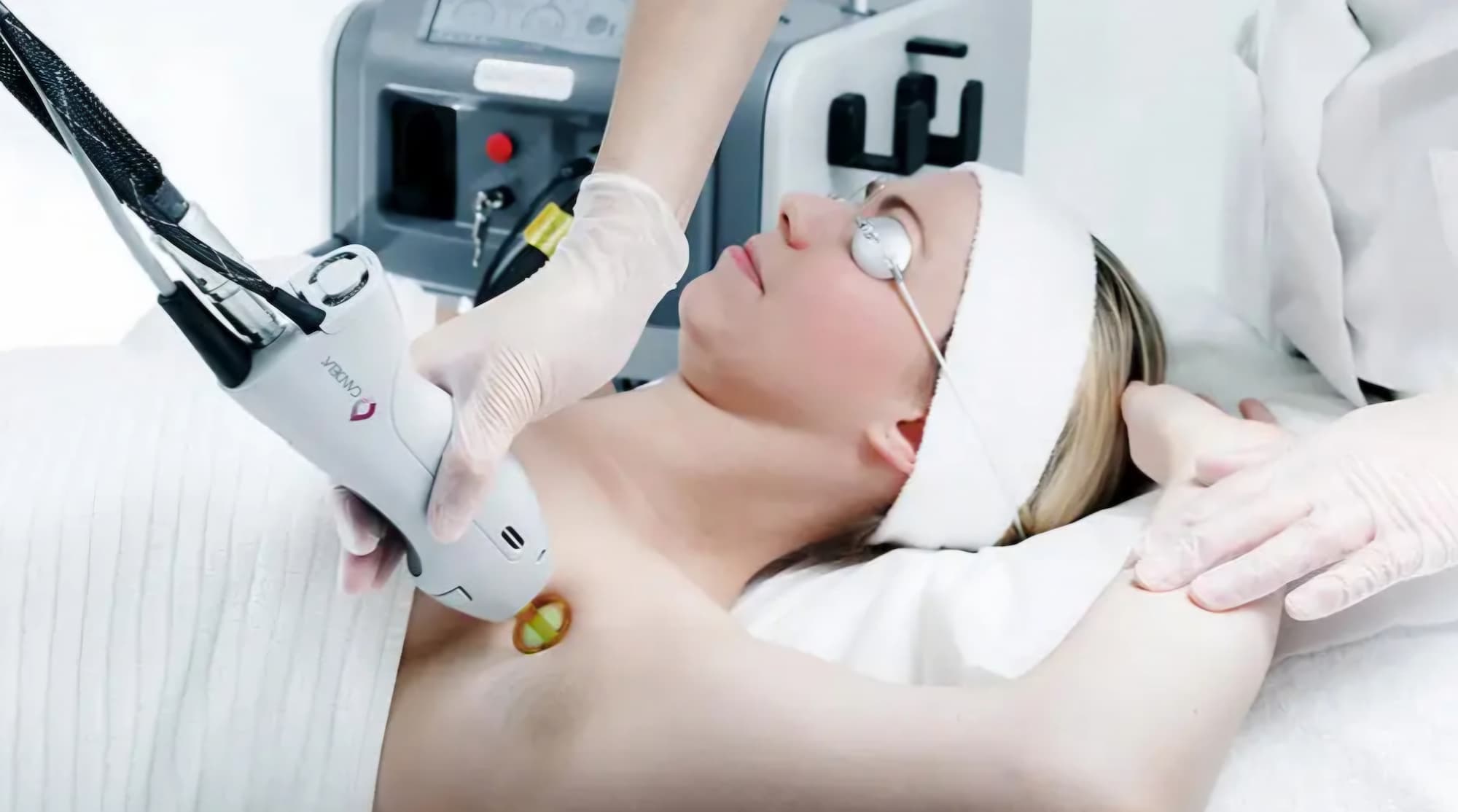
Does laser hair removal hurt? Most people feel some discomfort, but the sensation is brief and occurs with each laser pulse rather than as continuous pain. It is commonly described as a warm pinprick or the quick snap of a rubber band against the skin.
How uncomfortable it feels varies considerably from person to person—and even from one area of your own body to another.
Your hair thickness, treatment area, individual sensitivity, laser settings, and the cooling technology being used can all affect what you feel.
So if you’re considering laser hair removal but worried about pain, here’s a more realistic look at what treatment actually feels like.
What Does Laser Hair Removal Feel Like?
Laser hair removal does not usually feel like one prolonged painful sensation.
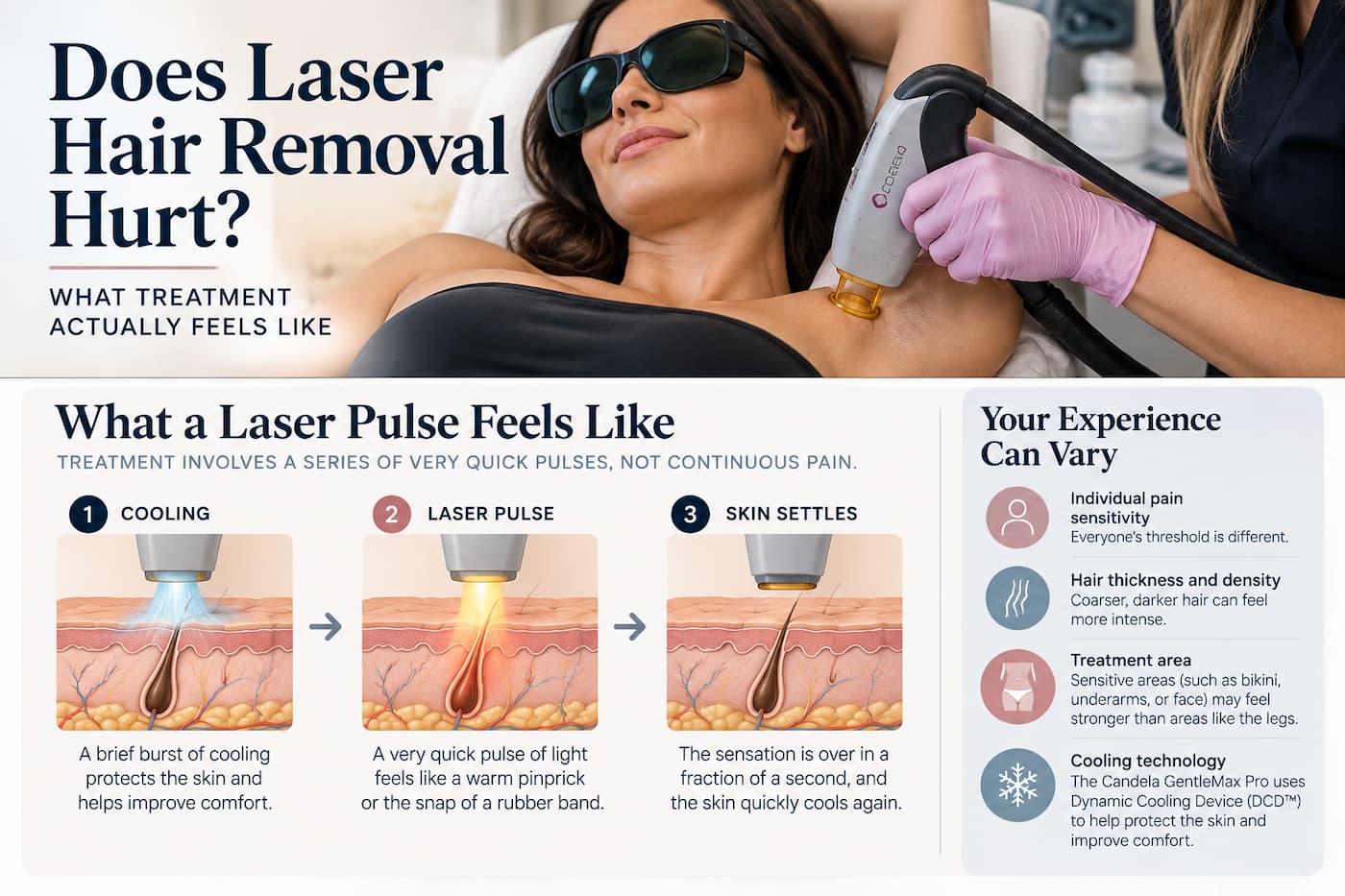
Instead, the laser delivers a series of very short pulses as the treatment area is covered.
The American Academy of Dermatology says many patients describe these pulses as feeling like warm pinpricks or a rubber band snapping against the skin.
Mayo Clinic gives a similar description and notes that patients may also feel a cooling sensation from the cooling device or gel used during treatment.
That means you may experience a repeating pattern of:
- A very quick hot or snapping sensation
- Immediate cooling
- Another brief pulse as the provider moves to the next spot
The sensation stops when the laser stops firing.
Why Does Laser Hair Removal Feel Hot?
The heat is part of how laser hair removal works.
The laser delivers light energy that is absorbed by pigment called melanin in the hair. That light energy converts to heat, which damages the hair follicle and inhibits future hair growth.
The goal is to deliver enough energy to effectively target the hair while protecting the surrounding skin.
That is also why laser hair removal should not be thought of as a completely sensation-free treatment. Heat is being intentionally delivered to a very specific target.
Does Laser Hair Removal Hurt More in Certain Areas?
It can.
There isn’t a reliable universal pain scale for every treatment area because individual sensitivity varies so much. However, an area with dense, coarse hair or greater natural sensitivity may feel more intense than an area with finer or more sparsely distributed hair.
You may therefore find that treating your lower legs feels quite different from treating your bikini area, underarms, upper lip, or another sensitive location.
Even within the same treatment area, individual laser pulses may feel different depending on the amount and thickness of hair beneath that particular spot.
Does Bikini Laser Hair Removal Hurt?
The bikini area can be sensitive, so some people find laser treatment there more uncomfortable than treatment on areas such as the lower legs.
That does not mean the entire appointment feels intensely painful.
Each pulse is extremely brief, and modern laser systems can incorporate cooling to make treatment more comfortable.
If you’re concerned about treating a sensitive area, tell your provider before treatment begins. Comfort is something that can be discussed rather than something you simply have to endure without saying anything.
Does Underarm Laser Hair Removal Hurt?
Underarm hair is often coarse and dark, which makes it a good laser target—but the underarm itself can also be sensitive.
Some patients notice a stronger snapping sensation there than they do on larger areas such as the legs.
The advantage is that the underarms are relatively small, so the treatment itself can be completed quickly.
Does Laser Hair Removal on the Face Hurt?
Areas such as the upper lip and chin can also feel sensitive.
The upper lip in particular is a small treatment area with many sensory nerves, so individual pulses can feel sharp even though the entire area may take only a few minutes to treat.
Mayo Clinic notes that a small area such as the upper lip can be treated in minutes, while a large area such as the back may take considerably longer.
How Does the Candela GentleMax Pro Make Treatment More Comfortable?
At Vital Glow, we perform laser hair removal with the Candela GentleMax Pro.
One of the important features of the system is Candela’s Dynamic Cooling Device (DCD™).
The system delivers a controlled burst of cryogen to the surface of the skin immediately around the laser pulse. This helps protect the epidermis while also improving patient comfort.
Candela’s Gentle Pro technology combines laser energy with its cooling system specifically to provide epidermal protection and improve comfort during treatment.
You may therefore notice both sensations during your appointment: the quick heat or snap of the laser pulse followed by—or associated with—a noticeably cold sensation at the skin.
Does Cooling Make Laser Hair Removal Painless?
No—and we would rather set a realistic expectation than promise a painless procedure.
Cooling can make treatment more comfortable and helps protect the surface of the skin, but you may still feel each laser pulse.
How much you feel depends on factors including:
- Your individual pain sensitivity
- The treatment area
- Hair thickness and density
- Your skin and hair characteristics
- The laser wavelength and treatment parameters being used
Someone who describes the treatment as very easy may be telling the truth about their experience. Someone who finds a particular area uncomfortable may be telling the truth too.
There is no single sensation that every patient experiences.
Can Numbing Cream Be Used for Laser Hair Removal?
Topical numbing medication may sometimes be used before laser hair removal, particularly for small or sensitive treatment areas.
Both the American Academy of Dermatology and Mayo Clinic note that topical numbing may be used to reduce discomfort in appropriate situations.
However, you should not apply a numbing product on your own before an appointment unless your treating provider has instructed you to do so.
The appropriate product, amount, treatment area, and timing matter. Discuss significant concerns about discomfort with your provider beforehand rather than attempting to numb a large area yourself.
Does Laser Hair Removal Hurt More During the First Session?
It can feel different as your treatment series progresses.
At the beginning of treatment, you may have a greater amount of coarse, pigmented hair available for the laser to target.
As treatment successfully reduces that hair, the density and characteristics of the remaining hair can change.
But treatment settings may also be adjusted based on your response, skin characteristics, hair characteristics, and the area being treated. For that reason, it would be misleading to promise that every appointment will automatically hurt less than the one before it.
If you’re wondering why laser hair removal requires multiple appointments in the first place, read How Many Laser Hair Removal Sessions Do You Need?
What Does Your Skin Feel Like After Laser Hair Removal?
Some redness, swelling, and mild discomfort after treatment are common.
The American Academy of Dermatology says the reaction can resemble a mild sunburn, while Mayo Clinic notes that mild swelling, discomfort, and skin-color changes commonly resolve within hours.
A cool compress can help with temporary discomfort.
Your provider should also give you aftercare instructions appropriate for the area treated and your skin.
We will cover laser hair removal aftercare—including exercise, heat, sun exposure, and skin care—in detail later in this series.
Is Pain a Sign That the Laser Is Working?
No.
How much a treatment hurts is not a useful way to judge whether the laser is effective.
More pain does not automatically mean more hair reduction, and turning treatment into a test of how much discomfort you can tolerate is not the goal.
Effective laser hair removal depends on selecting an appropriate laser wavelength and treatment parameters for the patient’s skin, hair, and treatment area.
The goal is effective treatment while appropriately protecting the surrounding skin—not creating the most intense sensation possible.
Should Laser Hair Removal Be Extremely Painful?
You should expect some sensation, but significant or unexpected pain should not simply be ignored.
Lasers can cause burns, blistering, scarring, and pigment changes when used improperly. The American Academy of Dermatology emphasizes that laser hair removal can cause serious complications in inexperienced hands.
If something feels dramatically different from what your provider has told you to expect, say something during the treatment.
Your provider can evaluate your skin and determine whether anything needs to be adjusted.
Is Laser Hair Removal More Painful Than Waxing?
The sensations are different, so there isn’t a scientifically meaningful answer that applies to everyone.
Waxing pulls many hairs from their follicles at once. Laser hair removal instead produces a series of rapid heat or snapping sensations as the treatment area is covered.
Some people strongly prefer laser. Others are more sensitive to the laser pulse.
There is another important difference, though: waxing is a temporary hair-removal method that must be repeated as the hair returns, while laser treatment is intended to produce long-term hair reduction.
We’ll compare the two methods more fully in our upcoming article on laser hair removal vs. waxing.
How Long Does the Discomfort Last?
The sensation from an individual laser pulse is very brief.
After treatment, temporary tenderness, redness, or swelling can occur. According to the American Academy of Dermatology, common minor side effects such as discomfort, redness, and swelling typically last about one to three days.
Most people do not require downtime after laser hair removal and can return to their normal daily activities, although specific aftercare restrictions still need to be followed.
Is Laser Hair Removal Worth the Discomfort?
That depends on how much unwanted hair bothers you and what you currently do to manage it.
Laser hair removal requires a treatment series and can involve some temporary discomfort.
In return, the goal is long-term reduction in unwanted hair rather than repeating shaving or waxing indefinitely.
As we explained in Is Laser Hair Removal Permanent?, the realistic goal is permanent hair reduction rather than a guarantee that every hair will be gone forever.
Whether that tradeoff makes sense for you is a personal decision.
Frequently Asked Questions
How painful is laser hair removal on a scale of 1 to 10?
There is no reliable universal number. Pain tolerance, treatment area, hair density, skin and hair characteristics, laser settings, and cooling can all affect the experience. A more useful description is that many patients report brief warm pinpricks or rubber-band-like snaps with each laser pulse.
What is the most painful area for laser hair removal?
There is no single most painful area for everyone. Sensitive areas and areas with dense, coarse hair may feel more intense, so the bikini area, underarms, and portions of the face can feel different from areas such as the legs.
Does laser hair removal hurt less than waxing?
Some people find laser treatment easier than waxing, while others do not. Waxing and laser produce different sensations, and individual pain tolerance varies considerably.
Can I use numbing cream before laser hair removal?
Topical numbing medication may be appropriate in some situations, but do not apply it before your appointment unless your provider has instructed you to do so. Discuss concerns about discomfort with your provider first.
Why does laser hair removal feel like a rubber band snapping?
The laser delivers very short pulses of light energy that are absorbed by pigment in the hair and converted to heat. That rapid delivery of heat can create the characteristic brief snapping or pinprick sensation.
Does the Candela GentleMax Pro have cooling?
Yes. The Candela GentleMax Pro incorporates Candela’s Dynamic Cooling Device (DCD™), which delivers a controlled burst of cryogen to help protect the skin and improve comfort during laser treatment.
Some Sensation Is Normal. Severe Pain Isn’t the Goal.
Laser hair removal isn’t necessarily painless, and we don’t think patients benefit from pretending that it is.
For most people, treatment involves a series of quick heat or snapping sensations rather than continuous pain. The treatment area, hair characteristics, individual sensitivity, and technology being used all influence how it feels.
At Vital Glow Men’s & Women’s Health, we use the Candela GentleMax Pro with integrated DCD cooling for laser hair removal in Columbia, SC.
If discomfort is one of the things keeping you from considering laser hair removal, a consultation gives you an opportunity to discuss the area you’d like treated, your skin and hair characteristics, and what you can realistically expect during treatment.
Learn More About Laser Hair Removal at Vital Glow
Medically reviewed by Candace Danbury, MSN, APRN, FNP-BC.