ED can involve hormones, circulation, stress, medications, metabolic health, and confidence. Learn how Vital Glow approaches ED treatment.


Erectile dysfunction (ED) is difficulty getting or keeping an erection firm enough for sex. It is common, treatable, and sometimes provides useful information about health beyond sexual function.
An occasional erection problem does not necessarily mean something is wrong. Stress, fatigue, alcohol, relationship circumstances, and other temporary factors can affect sexual performance.
When erectile difficulties become persistent or recurrent, however, it can be worth looking deeper.
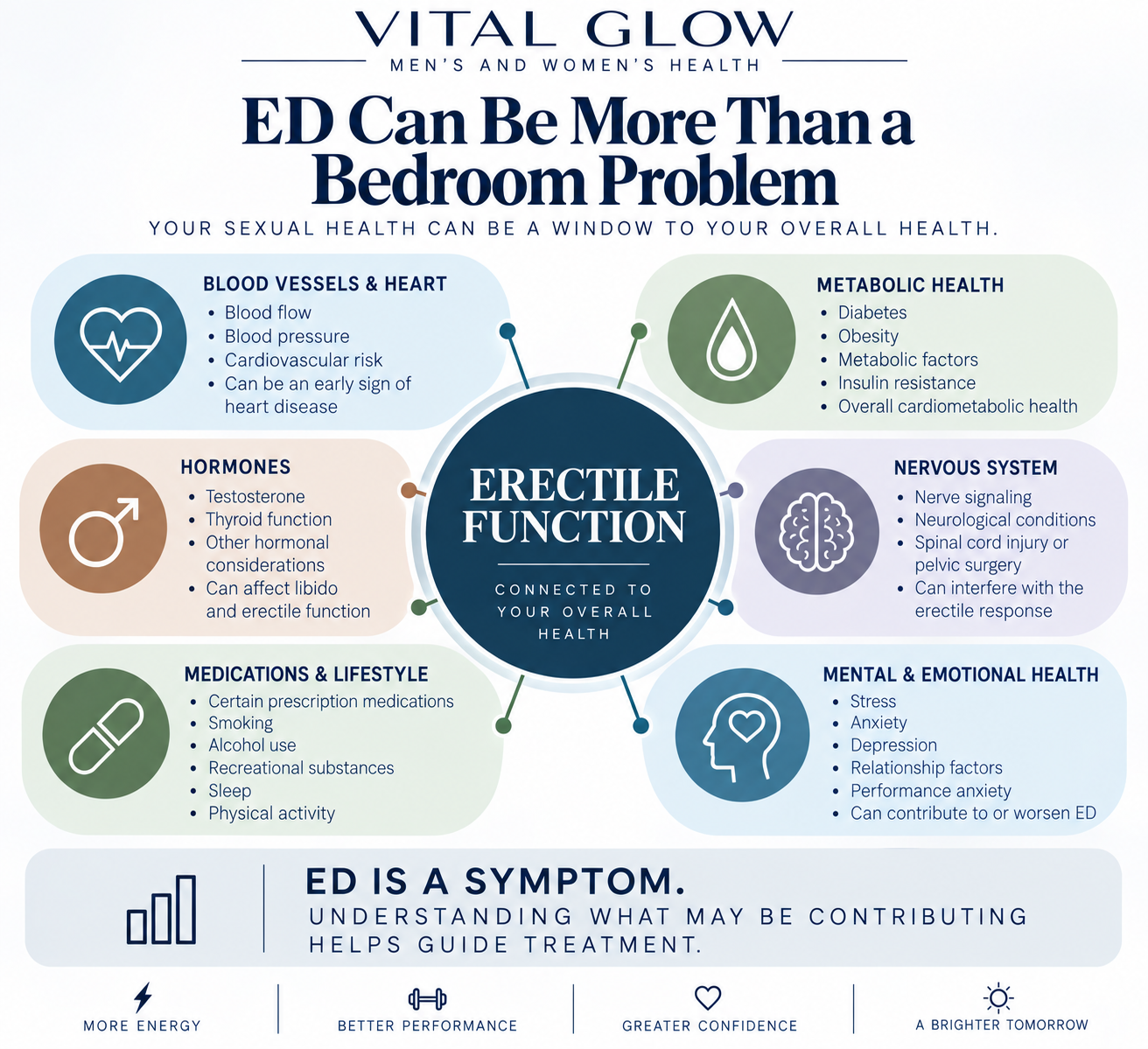
Blood-vessel health, diabetes, medications, hormones, neurological conditions, mental and emotional health, lifestyle factors, and other issues can all contribute to ED. That is why good erectile dysfunction care starts by asking why the problem is happening rather than automatically assuming every man needs the same treatment.
What Is Erectile Dysfunction?
Erectile dysfunction means consistently having difficulty getting or maintaining an erection that is firm enough for satisfactory sexual activity.
ED can look different from one person to another.
You might:
- Get an erection sometimes but not consistently
- Have difficulty becoming fully erect
- Get an erection but lose it before or during sex
- Be unable to get an erection
The National Institute of Diabetes and Digestive and Kidney Diseases emphasizes that ED becomes more common with age but should not simply be considered a routine or inevitable part of aging.
What Causes Erectile Dysfunction?
An erection requires several systems to work together.
Sexual stimulation involves the brain and nervous system. Blood vessels must deliver adequate blood flow to the penis. Hormones can affect sexual desire and function. Medications, health conditions, emotional state, and relationship circumstances can also influence the process.
Problems affecting any of these areas can contribute to ED.
Potential contributors include:
- Cardiovascular and blood-vessel disease
- High blood pressure
- Diabetes
- Overweight and obesity
- Hormonal conditions, including testosterone deficiency in some men
- Thyroid disorders
- Nerve damage or neurological conditions
- Pelvic surgery or injury
- Peyronie’s disease
- Certain prescription and nonprescription medications
- Smoking
- Excessive alcohol use
- Stress
- Anxiety
- Depression
- Relationship or sexual-performance concerns
Sometimes more than one factor is involved.
Can Erectile Dysfunction Be a Sign of a Heart or Blood-Vessel Problem?
Yes. Persistent ED can sometimes be an early clue to cardiovascular or blood-vessel disease.
An erection depends heavily on healthy blood flow. Conditions that damage blood vessels throughout the body can therefore affect erectile function as well.
The American Urological Association identifies ED as a risk marker for underlying cardiovascular disease and other health conditions that may warrant further evaluation.
More recent cardiovascular guidance has reinforced this connection. The Princeton IV Consensus Guidelines characterize ED as a cardiovascular risk marker and recommend considering cardiovascular risk when evaluating men with erectile dysfunction.
This does not mean that every man with ED has heart disease.
It means that persistent erectile dysfunction can be an opportunity to look at the bigger picture—particularly when other cardiovascular risk factors are present.
What Health Conditions Are Commonly Associated With ED?
Diabetes
Diabetes can affect both blood vessels and nerves, two systems that are important for normal erections.
Men with diabetes may therefore experience erectile dysfunction, particularly when vascular or neurological complications develop.
High Blood Pressure and Vascular Disease
Healthy erections require adequate blood flow.
High blood pressure, atherosclerosis, and other cardiovascular conditions can damage blood vessels and interfere with that process.
Obesity and Metabolic Health
Excess body weight can overlap with several conditions associated with ED, including diabetes, cardiovascular disease, sleep problems, and hormonal changes.
That does not mean weight is always the cause of ED, but metabolic health may be an important part of the overall evaluation.
Neurological Conditions
Nerves carry signals involved in sexual arousal and erection.
Neurological disease, spinal cord injury, nerve damage, or certain pelvic surgeries can interfere with those signals.
Does Low Testosterone Cause Erectile Dysfunction?
Low testosterone can contribute to sexual symptoms, but ED does not automatically mean testosterone is low.
Testosterone has an important role in libido and sexual health. Men with testosterone deficiency may experience reduced sexual desire, fewer spontaneous erections, and erectile difficulties.
But erections depend heavily on vascular and neurological function as well.
A man can therefore have erectile dysfunction with a normal testosterone level, and a man with low testosterone may have symptoms beyond erectile function.
The American Urological Association recommends measuring morning total testosterone in men being evaluated for ED.
If you’re experiencing other symptoms such as reduced libido, loss of muscle or strength, or unexplained changes in energy, read more about the symptoms and evaluation of low testosterone.
Can Medications Cause Erectile Dysfunction?
Yes. Some medications can contribute to erectile difficulties.
These may include certain:
- Blood-pressure medications
- Antidepressants
- Sedatives
- Pain medications
- Hormonal medications
- Other prescription or over-the-counter drugs
That does not mean you should stop taking a medication because you suspect it is affecting sexual function.
Stopping or changing prescription medication without medical guidance can be dangerous.
Instead, tell your healthcare provider what you are taking—including prescriptions, over-the-counter medications, vitamins, supplements, and recreational substances—so medication effects can be considered as part of the evaluation.
Can Stress or Anxiety Cause ED?
Yes.
Sexual function involves both physical and psychological processes. Stress, anxiety, depression, relationship difficulties, negative body image, and sexual-performance anxiety can contribute to erectile difficulties or make an existing physical problem worse.
One difficult sexual experience can sometimes create anxiety about the next encounter. That anxiety can then interfere with arousal and erections, creating a frustrating cycle.
Psychological contributors do not mean ED is “all in your head.”
Physical and psychological factors can occur together, and both deserve to be taken seriously.
How Is Erectile Dysfunction Evaluated?
An ED evaluation usually begins with a conversation.
Your healthcare provider may ask about:
- When the problem started
- Whether it occurs consistently or only in certain situations
- Whether you can get an erection but have difficulty maintaining it
- Morning or spontaneous erections
- Sexual desire
- Ejaculation or orgasm concerns
- Medical conditions
- Prescription and nonprescription medications
- Alcohol, tobacco, or recreational drug use
- Stress and emotional health
- Relationship or sexual circumstances when relevant
Not every patient requires every possible test.
The evaluation should be guided by the individual situation and what the provider is trying to determine.
What Blood Tests Might Be Used When Evaluating ED?
Laboratory testing can sometimes help identify health issues that may contribute to erectile dysfunction or influence treatment decisions.
The appropriate tests depend on the patient.
Morning testosterone testing is one consideration. Depending on medical history, symptoms, and previous testing, other laboratory evaluation may also be useful.
The purpose is not to order the largest possible panel. Testing should help answer a clinical question.
For more information, read about how Vital Glow approaches comprehensive laboratory testing.
How Is Erectile Dysfunction Treated?
Treatment depends on what appears to be contributing to the problem, the patient’s health, preferences, medications, and treatment goals.
Options can include:
- Addressing underlying health conditions
- Reviewing medications that may contribute to ED
- Lifestyle changes
- Counseling or therapy when psychological or relationship factors contribute
- Oral ED medications
- Vacuum erection devices
- Injectable medications or urethral therapies
- Testosterone treatment when genuine testosterone deficiency is present and treatment is appropriate
- Specialist evaluation or procedural treatment when needed
The right treatment is not necessarily the same for every man.
How Do Oral ED Medications Work?
Common oral erectile dysfunction medications belong to a group called phosphodiesterase type 5 (PDE5) inhibitors.
These medications improve the erectile response by supporting blood flow to the penis.
Examples include sildenafil and tadalafil.
They generally require sexual stimulation to produce an erection; taking the medication does not normally create an automatic erection in the absence of arousal.
Different medications vary in how quickly they begin working, how long their effects can last, dosing options, and how food or other factors may affect their use.
Are ED Medications Safe for Everyone?
No medication is appropriate for everyone.
One particularly important interaction involves nitrates, medications commonly used for chest pain and certain cardiovascular conditions.
PDE5 inhibitors and nitrates should not be combined because the combination can cause a dangerous drop in blood pressure.
This is one reason an ED medication should not simply be treated as a generic lifestyle product.
Your provider needs to know about your health conditions and medications before determining whether a particular treatment is appropriate.
What If ED Medication Doesn’t Work?
An unsuccessful experience with an oral ED medication does not necessarily mean there are no treatment options.
It may be useful to consider:
- Whether the medication was taken correctly
- Whether enough sexual stimulation was present
- Whether timing or food affected the medication
- Whether the dose or medication is appropriate
- Whether another health condition is contributing
- Whether hormonal or psychological factors need attention
Other treatments—including vacuum devices, injectable medications, and specialist procedures—are available for appropriate patients.
Persistent or complicated ED may warrant evaluation by a urologist or another specialist.
Can Lifestyle Changes Improve Erectile Function?
They can help some men, particularly when cardiovascular or metabolic factors contribute.
Healthy habits that support vascular health may also support erectile health.
Depending on the individual, that may include:
- Regular physical activity
- Stopping smoking
- Limiting excessive alcohol use
- Managing body weight
- Eating a heart-healthy diet
- Managing blood pressure, diabetes, and other health conditions
- Addressing chronic stress
Lifestyle changes do not guarantee that ED will resolve, and they should not be presented as a substitute for evaluation when erectile difficulties are persistent.
When Should You Talk to a Healthcare Provider About ED?
An occasional erection problem can happen to almost anyone.
Consider discussing ED with a healthcare provider when it:
- Happens repeatedly
- Persists over time
- Causes distress
- Affects your relationship or sex life
- Occurs along with reduced libido or other hormonal symptoms
- Begins after starting or changing a medication
- Occurs alongside cardiovascular or metabolic risk factors
- Is accompanied by penile pain, curvature, or another physical change
You do not need to wait until erections become completely impossible before bringing up the concern.
Why Treating the Cause Matters
Restoring erectile function may be an important treatment goal, but it should not always be the only goal.
If ED leads to the discovery of uncontrolled blood pressure, diabetes, medication effects, testosterone deficiency, cardiovascular risk, or another health issue, identifying that problem may be more important for long-term health than the erection itself.
Sometimes the evaluation does not reveal one clear underlying cause. Treatment can still focus on improving sexual function and quality of life.
The important point is that ED deserves more than embarrassment, assumptions, or a one-size-fits-all prescription.
Erectile Dysfunction Treatment in Columbia, SC
At Vital Glow, erectile dysfunction care begins with understanding what you’re experiencing and considering factors that may be contributing to it.
Depending on your situation, evaluation may include your medical and sexual history, medications, symptoms, cardiovascular and metabolic considerations, and laboratory testing when appropriate.
If treatment is appropriate, options can then be discussed based on your health, goals, and individual circumstances.
When a concern requires evaluation or treatment beyond the services available at Vital Glow, appropriate referral is part of good care.
Vital Glow provides men’s health services for patients in Columbia and surrounding Midlands communities.
Learn more about erectile dysfunction evaluation and treatment at Vital Glow →
Frequently Asked Questions About Erectile Dysfunction
What is the most common cause of erectile dysfunction?
There is no single cause that explains every case. ED can involve blood-vessel disease, diabetes, medications, neurological conditions, hormonal problems, psychological factors, lifestyle factors, or a combination of causes. Cardiovascular and vascular health are particularly important because erections depend on adequate blood flow.
Is erectile dysfunction a normal part of getting older?
ED becomes more common with age, but it should not simply be considered an inevitable part of aging. Health conditions, medications, vascular changes, hormones, and other potentially treatable factors may contribute.
Can ED be an early warning sign of heart disease?
ED is recognized as a cardiovascular risk marker. That does not mean every man with ED has cardiovascular disease, but persistent ED can be a reason to consider cardiovascular risk factors and overall health as part of the evaluation.
Does erectile dysfunction mean my testosterone is low?
No. Testosterone deficiency can contribute to sexual symptoms, but many men with ED do not have low testosterone. Erectile function also depends heavily on blood flow, nerve function, medications, psychological factors, and other aspects of health.
Can anxiety cause erectile dysfunction?
Yes. Anxiety, stress, depression, relationship concerns, and sexual-performance anxiety can cause or worsen erectile difficulties. Psychological and physical contributors can also occur at the same time.
What medications are commonly used for ED?
Oral PDE5 inhibitors such as sildenafil and tadalafil are commonly used treatments. The appropriate medication depends on health conditions, other medications, treatment goals, and individual circumstances.
Can I take ED medication if I have heart disease?
Some men with stable cardiovascular disease can use PDE5 inhibitors, but individual cardiovascular status and medications matter. PDE5 inhibitors must not be combined with nitrates because of the risk of a dangerous drop in blood pressure. Men with unstable or significant cardiovascular disease may require further evaluation before sexual activity or ED treatment.
What happens if pills don’t work for my ED?
Other options can include vacuum erection devices, injectable or urethral medications, counseling when appropriate, and specialist treatments. It can also be useful to determine whether the oral medication was used correctly and whether another health issue is contributing.
Medically reviewed by Candace Danbury, MSN, APRN, FNP-BC.