Short answer: Laser hair removal can produce long-lasting—and sometimes permanent—reduction in hair growth, but it does not guarantee that every treated hair will disappear forever. Some hair can eventually regrow, and occasional maintenance treatments may be needed. That distinction matters because the phrase “permanent laser hair removal” can create an expectation that after finishing treatment, …


Short answer: Laser hair removal can produce long-lasting—and sometimes permanent—reduction in hair growth, but it does not guarantee that every treated hair will disappear forever. Some hair can eventually regrow, and occasional maintenance treatments may be needed.
That distinction matters because the phrase “permanent laser hair removal” can create an expectation that after finishing treatment, you will never see another hair in the area again.
That is not the most accurate way to describe the treatment.
A better term is permanent hair reduction.
Understanding what that actually means can help you decide whether laser hair removal is worth it—and what a successful result should realistically look like.
What Does “Permanent Hair Reduction” Mean?
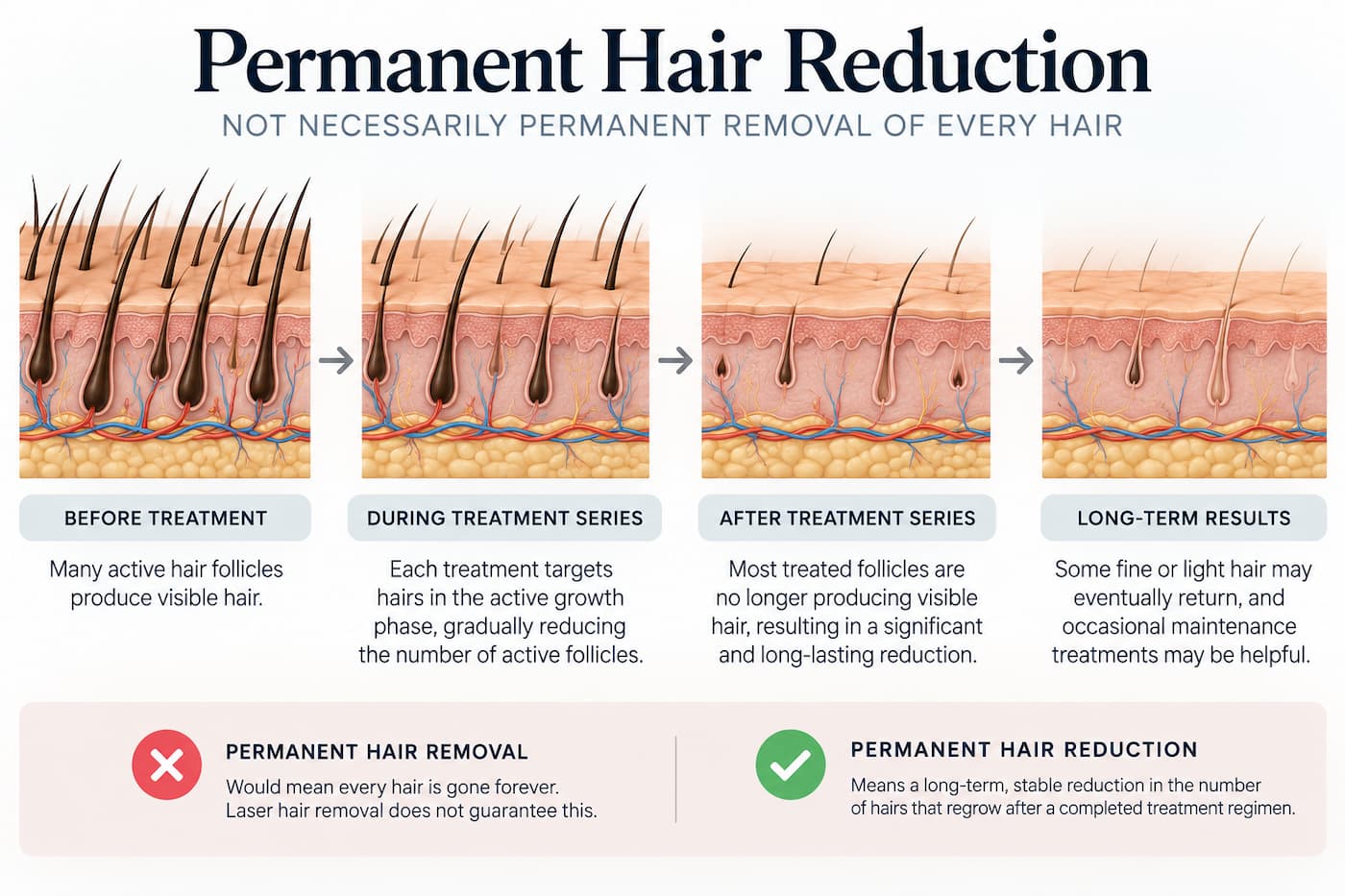
Permanent hair reduction has a more specific meaning than simply saying that laser hair removal is permanent.
In FDA documentation for hair-removal laser devices, permanent hair reduction is defined as a long-term, stable reduction in the number of hairs that regrow after completing a treatment regimen.
For example, FDA device documentation defines permanent reduction in hair regrowth based on a stable reduction measured months after treatment has been completed.
Notice what that definition does not say.
It does not promise:
- Every follicle will be permanently destroyed
- You will never see another hair in the treated area
- Hormonal changes cannot cause future hair growth
- Everyone will achieve the same percentage of reduction
Instead, the goal is a lasting decrease in how much hair grows in the treated area.
So Does Hair Grow Back After Laser Hair Removal?
It can.
The American Academy of Dermatology notes that many patients remain hair-free for months or even years after completing laser hair removal.
When hair eventually regrows, there is often less of it, and the returning hairs tend to be finer and lighter in color.
Mayo Clinic similarly explains that laser hair removal can greatly reduce hair growth but does not guarantee that hair will never grow back.
That means seeing a few hairs months or years later does not necessarily mean your treatment failed.
The more useful question is:
How much hair remains compared with where you started?
Why Can Hair Return After Laser Hair Removal?
Several things can contribute.
First, laser hair removal works across multiple hair-growth cycles.
Not every follicle is in an active growth phase during the same appointment. That is why treatment requires a series of sessions rather than one visit.
If you haven’t read the first article in this series, see How Many Laser Hair Removal Sessions Do You Need? for a detailed explanation of the hair-growth cycle and treatment spacing.
Second, not every follicle responds identically to treatment.
Some follicles may be damaged enough to stop producing a noticeable hair. Others may eventually produce a finer or lighter hair.
And your body can change over time.
Hormones Can Affect Future Hair Growth
Laser hair removal treats the hair follicles that can be effectively targeted during your treatment series.
It does not stop your hormones from changing in the future.
Hormonal changes can influence hair growth, particularly on areas such as the face and chin.
Mayo Clinic notes that unwanted hair can sometimes be associated with underlying hormonal conditions. Laser treatment can reduce the hair that is currently present, but it does not treat the underlying hormonal cause of new hair growth.
This distinction can be especially relevant with:
- Facial or chin hair
- Polycystic ovary syndrome (PCOS)
- Other conditions associated with excess hair growth
- Hormonal changes over time
In those situations, new hairs may develop even after earlier follicles were successfully treated.
That is different from every previously treated hair simply “coming back.”
Does the Treatment Area Affect How Permanent the Results Are?
Yes.
Hair growth is not identical across the body.
Areas such as the underarms, bikini area, legs, back, chest, neck, and face can differ in:
- Hair thickness
- Hair density
- Growth-cycle timing
- Hormonal sensitivity
- Long-term response to treatment
The American Academy of Dermatology specifically notes that hormonal influences can affect how permanent laser hair removal results are on a woman’s face.
This is one reason it is difficult to give every patient the same prediction about exactly how long results will last.
Does Hair Color Affect Long-Term Results?
Yes.
Laser hair removal works by targeting pigment—melanin—in the hair.
Dark, coarse hair generally provides a stronger target because it contains more pigment for the laser to absorb.
White, gray, and some very light blonde or red hairs contain less of the pigment conventional hair-removal lasers need to target effectively.
Mayo Clinic notes that laser hair removal generally works best on darker hair and is less effective on blonde, white, gray, and red hair.
This also explains something patients sometimes notice later in a treatment series:
The remaining hair may become harder to treat because the darker, coarser hairs responded first, leaving finer or lighter hairs behind.
Does Skin Tone Affect Whether Results Last?
Skin tone affects how laser treatment should be performed, but it does not mean that only people with light skin can receive laser hair removal.
The laser needs to target pigment in the hair while protecting the surrounding skin.
Modern laser systems can use different wavelengths and treatment parameters for different skin types.
At Vital Glow, we use the Candela GentleMax Pro, which combines Alexandrite and Nd:YAG wavelengths to allow treatment across a broad range of skin tones when appropriate.
We will cover this subject separately in our upcoming article about laser hair removal for darker skin tones, because skin color, hair color, wavelength, and treatment settings deserve more explanation than a few sentences here.
Will You Need Maintenance Laser Hair Removal?
You might.
The American Academy of Dermatology notes that maintenance laser treatments may be needed to keep an area hair-free after the initial treatment series.
Mayo Clinic also notes that occasional follow-up treatments may help maintain results.
Maintenance does not necessarily mean returning every few weeks indefinitely.
For someone who has achieved substantial long-term reduction, maintenance might mean an occasional treatment when enough noticeable hair has returned to make another session worthwhile.
Some people may need very little maintenance.
Others—particularly those with hormonally influenced hair growth—may need it more often.
Is Laser Hair Removal Better Described as Reduction or Removal?
If we’re being precise, reduction is the better expectation.
The treatment is commonly called laser hair removal because it removes and reduces unwanted hair.
But the medically useful goal is not to promise that every follicle in a treatment area will be permanently incapable of producing another hair.
The goal is to achieve a substantial, lasting reduction in unwanted hair.
For many people, that can mean:
- Much less visible hair
- Slower regrowth
- Finer regrowing hair
- Less frequent shaving
- Less irritation from repeated hair removal
- Fewer problems associated with shaving or ingrown hairs
For someone who previously shaved every day or dealt constantly with coarse stubble, that reduction can still represent a major practical difference.
What Does a Good Laser Hair Removal Result Look Like?
A good result should be judged against where you started—not against the unrealistic expectation that human skin must remain completely hairless forever.
Questions worth asking include:
- Is there substantially less hair than before treatment?
- Does the remaining hair grow more slowly?
- Is the regrowing hair finer or lighter?
- Do you shave much less often?
- Has irritation from shaving or waxing decreased?
- Are you satisfied with the amount of reduction?
Those are often more useful measures of success than counting an occasional individual hair.
What If a Lot of Hair Comes Back?
If substantial hair returns after completing an appropriate treatment series, it is worth looking at why rather than automatically assuming you simply need endless laser sessions.
Possible considerations include:
- Whether the original treatment series was completed
- Whether sessions were appropriately spaced
- The color and thickness of the remaining hair
- The treatment area
- Whether hormonal factors may be contributing
- Whether the laser and settings were appropriate for your skin and hair
- How much reduction was actually achieved compared with baseline
Sometimes additional laser treatment makes sense.
Sometimes the remaining hair no longer provides a good laser target.
And sometimes new or changing hair growth deserves a broader medical evaluation.
Can Laser Hair Removal Ever Cause More Hair Growth?
Rarely, increased or thicker hair growth can occur in or around a treated area.
Mayo Clinic lists thicker hair growth around treated skin as a rare potential adverse effect of laser hair removal.
This phenomenon is sometimes called paradoxical hypertrichosis.
It is different from ordinary regrowth after laser hair removal and deserves its own discussion rather than being lumped together with normal maintenance.
We’ll cover paradoxical hair growth in detail in the final article of this laser hair removal series.
Is Laser Hair Removal Worth It If It’s Not Guaranteed Forever?
That depends on what you expect from the treatment.
If your definition of success is that you will never see another hair anywhere in the treatment area for the rest of your life, laser hair removal cannot responsibly guarantee that outcome.
If your goal is to substantially reduce unwanted hair for the long term, reduce how frequently you shave or wax, and make any future regrowth less noticeable, laser hair removal may offer exactly the kind of result you’re looking for.
The important part is starting treatment with realistic expectations.
Frequently Asked Questions
Does laser hair removal last forever?
Some treated follicles may stop producing hair permanently, but laser hair removal does not guarantee that every hair will be gone forever. Many patients remain hair-free for months or years, and when hair returns there is often less of it and it may be finer or lighter.
Why is my hair growing back after laser hair removal?
Some regrowth is possible because not every follicle responds identically, hairs grow in different cycles, and hormonal changes can contribute to future hair growth. Early in a treatment series, seeing new hairs is expected because multiple growth cycles still need to be treated.
Does laser hair removal become permanent after six sessions?
There is no specific session count that guarantees permanent results. Six treatments is a common treatment-series estimate, but some people need fewer or more depending on the area, hair characteristics, skin type, hormones, and individual response.
How often will I need maintenance laser hair removal?
There is no universal maintenance schedule. Some people need little or no maintenance for long periods, while others benefit from occasional treatments when noticeable hair returns.
Will regrown hair be the same as before?
Often it is not. The American Academy of Dermatology notes that when hair regrows after laser treatment, there tends to be less of it and the hairs often become finer and lighter.
Can hormones make hair grow back after laser treatment?
Yes. Hormonal influences can stimulate new hair growth, particularly in areas such as the face and chin. Laser hair removal can treat appropriate existing hairs but cannot prevent every future hormonally driven hair from developing.
Think Long-Term Reduction, Not a Lifetime Guarantee
The word “permanent” is useful only when we understand what it means.
Laser hair removal can create a long-term, stable reduction in unwanted hair. Many people remain hair-free for months or years, and any hair that eventually returns may be less noticeable.
But no responsible provider should promise that every treated follicle will remain completely hair-free for the rest of your life.
At Vital Glow Men’s & Women’s Health, we provide laser hair removal in Columbia, SC using the Candela GentleMax Pro dual-wavelength laser system.
Our goal is to help you understand what laser hair removal can realistically accomplish, how many treatments you may need, and what long-term maintenance may look like for your skin and hair.
Learn More About Laser Hair Removal at Vital Glow
Medically reviewed by Candace Danbury, MSN, APRN, FNP-BC.