Learn why comprehensive lab testing helps guide safer hormone, weight loss, wellness, TRT, HRT, and fatigue care at Vital Glow.

Lab testing can provide important information before starting hormone therapy, medical weight loss, hair restoration, or other medical wellness care—but a lab result should not be interpreted in isolation.
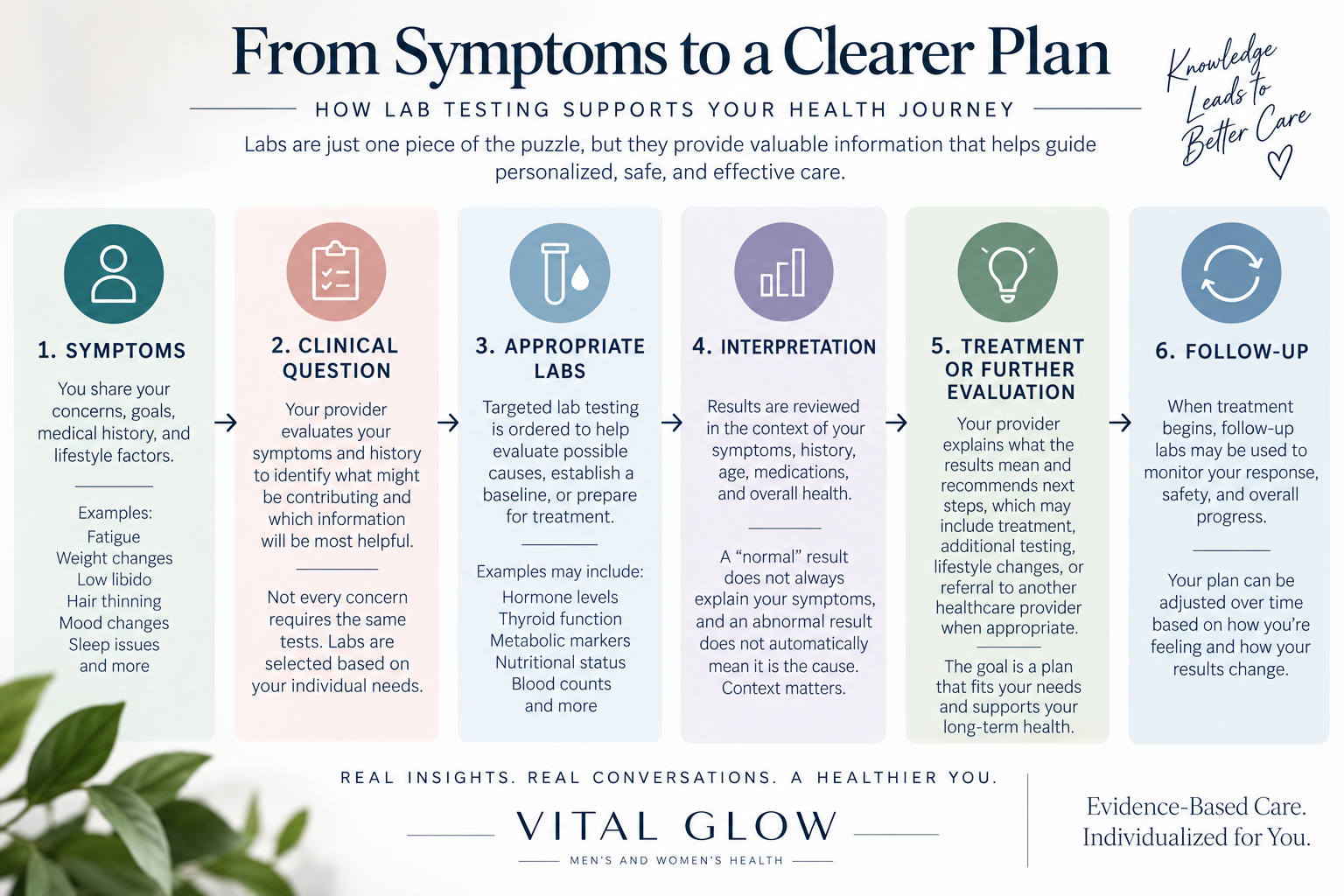
Symptoms such as fatigue, changes in weight, low libido, hair thinning, poor sleep, reduced strength, or simply “not feeling like yourself” can have many possible causes. Laboratory testing can help identify or rule out some of those possibilities, establish a baseline before certain treatments, and give your provider information to follow over time.
But more testing is not automatically better. The useful question is not, “How many labs can we order?” It is, “Which information will actually help us understand what is happening and make an appropriate treatment decision?”
Why Are Labs Important Before Starting Treatment?
Many symptoms that bring people to a hormone or wellness clinic overlap.
Fatigue is a good example. A person experiencing low energy might wonder whether testosterone, estrogen, thyroid function, nutrition, sleep, medication, stress, anemia, metabolic health, or another issue is contributing.
A symptom alone usually cannot answer that question.
Appropriate laboratory testing gives your provider objective information that can be considered alongside your symptoms, medical history, medications, physical findings, and goals.
Depending on the reason for your visit, labs may help your provider:
- Investigate possible contributors to your symptoms
- Determine whether additional evaluation is appropriate
- Establish baseline measurements before treatment
- Identify findings that could affect treatment decisions
- Monitor effectiveness or safety after treatment begins
- Recognize when your symptoms may need evaluation outside the services offered by a wellness practice
That last point matters. Sometimes useful testing leads toward treatment. Other times it provides a reason to investigate something else.
Labs Should Answer a Clinical Question
A long list of laboratory values can look comprehensive without necessarily being useful.
The appropriate tests depend on why you are being evaluated.
Someone being evaluated for possible testosterone deficiency may need different testing than someone seeking help for hair thinning, menopause symptoms, or medical weight management.
For example, the Endocrine Society’s clinical guidance on testosterone deficiency recommends diagnosing hypogonadism only when a man has signs or symptoms consistent with testosterone deficiency and consistently low testosterone concentrations. It also recommends confirming an initially low result with a repeat morning fasting testosterone measurement.
That illustrates an important principle: good medical decision-making connects the test to the clinical question.
A “Normal” Result Does Not Always Explain Your Symptoms
Laboratory reference ranges are useful, but they are not a complete explanation of how someone feels.
A result falling inside a laboratory reference range does not prove that every possible medical cause of a symptom has been ruled out. Likewise, a result outside a reference range does not automatically prove that it is causing your symptoms.
Results need context.
Your provider may consider factors such as:
- Your symptoms and when they began
- Your age and sex
- Medical conditions
- Prescription and nonprescription medications
- Previous laboratory results
- Changes in weight or nutrition
- Menstrual or reproductive history when relevant
- Sleep and lifestyle factors
- The timing and conditions under which a test was performed
Sometimes repeating a test is more useful than immediately treating an unexpected result.
Hormone Testing: Why Timing and Context Matter
Hormone testing is one area where a single number can be particularly easy to overinterpret.
Testosterone
Testosterone levels vary, including across the course of a day. When evaluating men for testosterone deficiency, the Endocrine Society recommends using symptoms together with consistently low testosterone measurements and confirming the diagnosis with repeat morning testing.
The Society reiterated in 2026 that symptoms such as low energy, libido changes, and mood changes can have multiple causes and that symptoms alone do not establish testosterone deficiency.
Depending on the findings, additional testing may sometimes be appropriate to investigate why testosterone is low rather than simply treating the number.
If you’re specifically concerned about testosterone symptoms, you can learn more about testosterone replacement therapy and evaluation at Vital Glow.
Women’s Hormones
Women’s hormone evaluation can be more complicated because hormone levels and symptoms can change with age, menstrual cycles, perimenopause, menopause, medications, and other factors.
That means hormone care should not become a contest to push every laboratory value toward a predetermined “optimal” number.
The goal is to understand the patient’s symptoms, health history, life stage, treatment goals, potential risks, and the information that testing can meaningfully provide.
Women experiencing symptoms such as hot flashes, sleep disruption, vaginal or urinary symptoms, libido changes, or other concerns can learn more about women’s hormone replacement therapy at Vital Glow.
What About Thyroid Testing?
Thyroid disorders can cause symptoms that overlap with complaints commonly attributed to hormones or aging, including fatigue, changes in weight, and changes involving the hair or skin.
That does not mean every symptom is caused by the thyroid—or that everyone needs an extensive thyroid panel.
Rather, thyroid testing may be useful when a person’s symptoms, history, examination, or other findings make thyroid dysfunction a reasonable consideration.
The American Academy of Dermatology, for example, notes that thyroid disease can produce changes involving the skin, hair, and nails and recommends medical evaluation when those signs occur.
Can Labs Help Evaluate Hair Thinning?
Sometimes.
Hair loss has many possible causes, and not all of them will show up on a blood test. Pattern hair loss, inflammatory scalp conditions, medication effects, nutritional deficiencies, hormonal changes, illness, stress-related shedding, and other conditions can produce different patterns of hair loss.
The American Academy of Dermatology’s guidance on diagnosing hair loss notes that blood testing may be appropriate when a dermatologist suspects a disease, vitamin deficiency, hormone imbalance, or infection.
Testing may therefore be one part of evaluating hair loss, but it should not replace examination of the scalp, the pattern and timing of hair loss, medical history, and other relevant information.
This is also why automatically taking large doses of “hair vitamins” isn’t necessarily a good substitute for figuring out what is happening. The AAD recommends supplementing certain nutrients such as iron or zinc when testing identifies a deficiency rather than assuming more is better.
Vital Glow also offers hair restoration evaluations for patients interested in understanding their options.
Labs and Medical Weight Management
Laboratory testing can also provide useful context when someone seeks medical help with weight management.
The appropriate evaluation varies by patient. A provider may need to understand existing metabolic conditions, medications, medical history, previous weight-loss attempts, and other factors before recommending treatment.
Labs can contribute useful information, but they do not replace the broader evaluation.
For someone considering prescription weight-loss treatment, the goal should be to determine whether a particular approach is medically appropriate—not simply to obtain a prescription as quickly as possible.
You can learn more about Vital Glow’s approach to medical weight loss, including consultation and ongoing treatment support.
Why Establish a Baseline Before Treatment?
Some laboratory testing is valuable not because your provider expects to discover the cause of a symptom, but because it establishes where you were before treatment began.
A baseline gives future results something meaningful to be compared with.
This can help answer questions such as:
- Did the laboratory value change after treatment?
- Is treatment producing the intended physiological effect?
- Has another measurement changed in a way that requires attention?
- Should the treatment plan or dose be reconsidered?
For example, appropriate monitoring is an established part of testosterone therapy. The Endocrine Society recommends evaluating patients after treatment begins to assess response, adverse effects, and adherence, with additional monitoring determined by the patient’s circumstances.
More Testing Is Not Necessarily Better Testing
It can be tempting to assume that the most thorough clinic is the one that orders the largest panel.
But testing without a reason can produce information that is difficult to interpret, unnecessary expense, or abnormal findings that may have little clinical significance.
A better approach is targeted comprehensiveness: collect enough information to appropriately evaluate the patient’s concern without treating every possible laboratory measurement as something that needs to be optimized.
When a test is ordered, it should ideally be possible to explain:
- What are we measuring?
- Why are we measuring it?
- How could the result affect our decision?
- Would an abnormal result require confirmation or additional evaluation?
- Will we need to monitor it if treatment begins?
What Happens If Your Labs Show Something Unexpected?
An unexpected laboratory result does not necessarily mean you have a new diagnosis.
Depending on the result, the appropriate next step could include repeating the test, considering other medications or conditions that could affect it, ordering additional evaluation, modifying a proposed treatment plan, or referring you to another healthcare professional.
That is one of the most important reasons labs should be interpreted rather than simply displayed on a patient portal.
Questions to Ask About Your Lab Results
You don’t need to become an expert in laboratory medicine to participate in the conversation about your results.
Useful questions include:
- Why was this test ordered?
- Which results are most relevant to my symptoms?
- Are any results unexpected?
- Does anything need to be repeated or confirmed?
- Could medications or other factors have affected the result?
- Does this result actually change what you recommend?
- What will we monitor if I start treatment?
- Is there anything here that should be evaluated by my primary care physician or a specialist?
Comprehensive Lab Testing at Vital Glow
At Vital Glow, laboratory testing is used as one part of a broader clinical picture. The purpose is not simply to collect as many numbers as possible. It is to gather information that can help guide an individualized evaluation and, when appropriate, treatment and follow-up.
Depending on why you’re being evaluated, that may involve hormone-related testing, metabolic markers, nutritional considerations, or other laboratory work selected according to your symptoms, history, and treatment plan.
Vital Glow provides men’s and women’s health and wellness services for patients in Columbia and surrounding Midlands communities.
Learn more about comprehensive lab testing at Vital Glow →
Frequently Asked Questions About Lab Testing
Do I need lab work before starting hormone therapy?
Appropriate evaluation before hormone therapy commonly includes laboratory testing, but the specific tests depend on the patient and the treatment being considered. For testosterone deficiency in men, for example, diagnosis requires symptoms together with consistently low testosterone measurements rather than symptoms or a single result alone.
Can blood tests tell me why I’m tired?
Blood tests can identify or help evaluate some possible contributors to fatigue, but there is no single blood test that explains every case. Medical history, medications, sleep, lifestyle, symptoms, physical findings, and other factors may also be important.
Should every hormone be tested?
Not necessarily. Testing is most useful when the result can help answer a clinical question or influence treatment. The appropriate hormone tests depend on your symptoms, sex, age, medical history, medications, and reason for evaluation.
Can my labs be normal even if I don’t feel well?
Yes. Reference ranges cannot evaluate every possible cause of a symptom, and many symptoms have causes that are not identified by routine laboratory testing. Persistent or concerning symptoms should be evaluated in their broader clinical context.
Why might a lab test need to be repeated?
Some measurements naturally fluctuate, and testing conditions can affect certain results. An unexpected result may also need confirmation before it is used to make a diagnosis or treatment decision. Testosterone testing in men is one example where repeat measurement is specifically recommended when evaluating suspected deficiency.
Will I need labs again after starting treatment?
That depends on the treatment. Some therapies require follow-up laboratory monitoring to evaluate response or safety. Your provider should explain what will be monitored and why before or when treatment begins.
Medically reviewed by Candace Danbury, MSN, APRN, FNP-BC.