Understand perimenopause, menopause, and common hormone symptoms women may experience, including sleep, mood, hot flashes, libido, and weight changes.


Perimenopause and menopause are related, but they are not the same thing. Perimenopause is the transition leading up to menopause, while menopause marks the point when you have gone 12 consecutive months without a menstrual period.
For many women, the confusing part is everything that happens in between.
Periods may become unpredictable. Hot flashes or night sweats can appear. Sleep may change. Some women notice vaginal dryness, changes in sexual function, mood changes, difficulty concentrating, or changes in body composition. Other women experience very few symptoms.
And because many of these changes can have other causes, figuring out whether you’re entering perimenopause is not always as simple as ordering one hormone test.
What Is the Difference Between Perimenopause and Menopause?
The easiest way to understand the terminology is to think of menopause as a point in time and perimenopause as the transition surrounding it.
Perimenopause
Perimenopause—also called the menopausal transition—is the period when ovarian function and hormone production begin changing as the body moves toward menopause.
One of the first noticeable signs is often a change in menstrual cycles.
Periods may:
- Come closer together or farther apart
- Become heavier or lighter
- Last longer or become shorter
- Become increasingly unpredictable
- Eventually be skipped for months at a time
According to The Menopause Society, these changes occur as ovarian hormone production becomes more erratic and ovulation occurs less frequently.
Menopause
Menopause is reached after 12 consecutive months without a menstrual period or spotting, assuming the absence of another cause.
The National Institute on Aging describes menopause as a normal part of aging rather than a disease or disorder.
Once menopause has occurred, the years afterward are referred to as postmenopause.
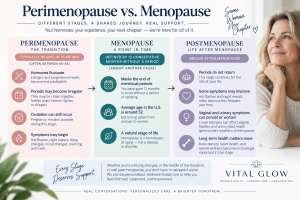
Perimenopause is the transition leading to menopause, menopause is reached after 12 consecutive months without a period, and postmenopause describes the years that follow.
At What Age Does Perimenopause Usually Begin?
There is no exact birthday when perimenopause begins.
The menopausal transition commonly begins during midlife, often in the 40s, although timing varies considerably from one woman to another.
The National Institute on Aging reports that most women begin the menopausal transition between ages 45 and 55 and that the transition can last several years.
The average age of menopause in the United States is approximately 52.
That means a woman may experience symptoms and menstrual changes for years before actually reaching menopause.
What Are the First Signs of Perimenopause?
Changes in menstrual patterns are often among the earliest clues.
But there is no single symptom pattern that every woman follows.
Possible changes during the menopausal transition include:
- Irregular menstrual periods
- Hot flashes
- Night sweats
- Difficulty sleeping
- Mood changes or irritability
- Difficulty concentrating or “brain fog”
- Vaginal dryness or irritation
- Pain or discomfort with sex
- Changes in sexual desire
- Urinary symptoms
- Joint or muscle discomfort
- Changes in body composition or weight distribution
The Menopause Society emphasizes that the menopause transition varies substantially among women. Some experience significant symptoms, while others experience few physical changes beyond their menstrual cycles.
Why Do Periods Become Irregular During Perimenopause?
During the reproductive years, ovulation and ovarian hormone production generally follow a more predictable cycle.
During perimenopause, ovulation becomes less consistent and production of hormones such as estrogen and progesterone becomes more variable.
As a result, the menstrual cycle can become less predictable.
Early in the transition, the changes may be subtle. Later, women may begin skipping periods for longer stretches.
Eventually, the final menstrual period occurs. Menopause is confirmed retrospectively once 12 months have passed without another period.
Are Hot Flashes and Night Sweats Normal During Perimenopause?
Yes. Hot flashes and night sweats—collectively called vasomotor symptoms—are among the most recognizable symptoms of the menopausal transition.
A hot flash is typically a sudden sensation of heat, often involving the face, neck, and upper body. Sweating, flushing, chills, or a rapid heartbeat may accompany it.
When these episodes occur during sleep, they are commonly called night sweats.
For some women they are occasional and mildly annoying. For others they can interrupt work, sleep, and daily life.
Not every woman experiences them, and their frequency and severity vary considerably.
Can Perimenopause Affect Sleep?
Yes, although menopause is not the only possible reason for sleep problems during midlife.
Night sweats can directly interrupt sleep. Mood changes, stress, urinary symptoms, and other health or life factors may also contribute.
Some women have difficulty falling asleep, wake frequently during the night, or wake earlier than they would like.
Because poor sleep can itself affect energy, concentration, mood, appetite, and overall well-being, it can become difficult to separate one symptom from another.
What Is “Menopause Brain Fog”?
Some women describe difficulty concentrating, forgetfulness, problems retrieving words or names, or simply feeling less mentally sharp during the menopause transition.
This is often informally called “brain fog.”
These experiences can be frustrating, but cognitive symptoms during midlife do not automatically indicate a serious cognitive disorder.
Sleep disruption, stress, mood symptoms, medications, and other health conditions may also affect concentration and memory, so significant or concerning cognitive changes deserve appropriate evaluation.
Can Perimenopause Affect Mood?
Mood can change during the menopausal transition, but the relationship is complex.
Women may experience irritability, mood changes, anxiety, or depressive symptoms during midlife. Hormonal fluctuations may contribute, but sleep disruption, stress, previous mental health history, relationships, work demands, caregiving responsibilities, and other factors can also matter.
Persistent depression, severe anxiety, or other significant mental health symptoms should not simply be dismissed as “just hormones.”
What Happens to Vaginal and Urinary Health Around Menopause?
Declining estrogen can affect tissues of the vulva, vagina, bladder, and urinary tract.
Women may experience:
- Vaginal dryness
- Burning or irritation
- Discomfort or pain with penetration
- Changes in sexual function
- Urinary urgency or frequency
- Recurring urinary concerns
These changes are collectively referred to as the genitourinary syndrome of menopause (GSM).
Unlike some menopausal symptoms that may improve with time, vaginal and urinary symptoms can persist or worsen without treatment.
Can You Still Get Pregnant During Perimenopause?
Yes.
Ovulation becomes less predictable during perimenopause, but it has not necessarily stopped.
That means pregnancy can still occur even when periods have become irregular or you have skipped several cycles.
Menopause cannot be established until 12 months have passed since the final menstrual period.
Women who do not want to become pregnant should discuss contraception with an appropriate healthcare provider rather than assuming irregular periods mean pregnancy is no longer possible.
Do You Need a Hormone Test to Diagnose Perimenopause?
Usually, there is no single laboratory test that can definitively tell you that you are in perimenopause.
This is one of the most important misconceptions surrounding menopause care.
Hormone levels can fluctuate considerably during the transition. A blood test captures what was happening at one point in time, which may not represent what happens throughout the rest of the cycle or over the following weeks and months.
For women in the typical age range with characteristic menstrual changes and symptoms, the clinical history may provide more useful information than repeatedly checking reproductive hormone levels.
Testing can still be appropriate in certain circumstances—for example, when symptoms are unusual, periods stop earlier than expected, another medical condition is being considered, or the result could meaningfully affect management.
When laboratory testing is useful, it should answer a clinical question rather than simply generate a collection of hormone numbers. You can read more about how laboratory testing can support hormone and wellness evaluation.
Could Perimenopause Symptoms Actually Be Something Else?
Possibly.
Many symptoms associated with perimenopause are nonspecific.
Fatigue, weight changes, sleep problems, mood changes, hair changes, changes in libido, and difficulty concentrating can occur for many reasons.
Depending on your symptoms and health history, an evaluation may consider other possible contributors rather than automatically attributing everything happening in midlife to menopause.
That is particularly important when symptoms are new, severe, unusual, or inconsistent with the expected menopausal transition.
When Is Bleeding During Perimenopause a Reason to Seek Medical Care?
Menstrual changes are common during perimenopause, but that does not mean every bleeding pattern should automatically be attributed to hormones.
The National Institute on Aging recommends medical evaluation if:
- Periods occur very close together
- Bleeding is unusually heavy
- Bleeding or spotting occurs between periods
- Bleeding occurs after sex
- A period lasts longer than a week
- Bleeding or spotting returns after more than a year without a period
Abnormal or concerning bleeding deserves appropriate evaluation rather than simply assuming it is part of perimenopause.
When Should You Consider Treatment for Menopause Symptoms?
Not every woman needs treatment simply because she has entered perimenopause or menopause.
The more useful question is whether symptoms are bothersome, affecting quality of life, or creating a health concern that should be addressed.
Depending on the symptom and individual health history, management may include lifestyle approaches, nonhormonal treatments, hormone therapy, local vaginal treatments, or other strategies.
Treatment should be selected according to the symptoms being treated, the woman’s medical history and risk factors, and her preferences.
Is Hormone Therapy Only for Women Who Have Already Reached Menopause?
No.
Women do not necessarily have to wait until their periods have completely stopped before discussing treatment for bothersome menopausal symptoms.
Hormone therapy is an established treatment for certain menopause-related symptoms, particularly bothersome hot flashes and night sweats, and treatment decisions can be considered during the menopausal transition when appropriate.
However, hormone therapy is not automatically the right treatment for every symptom or every woman.
The type of therapy, route of administration, whether a progestogen is needed, medical history, reproductive status, symptoms, risks, and treatment goals all matter.
If symptoms are affecting your quality of life, you can learn more about women’s hormone therapy and menopause care at Vital Glow.
Perimenopause and Menopause Care in Columbia, SC
At Vital Glow, women’s hormone care begins with understanding what has changed—not simply looking for a laboratory number to correct.
An evaluation may include your menstrual history, symptoms, medical history, medications, treatment goals, risk factors, and laboratory testing when it can provide useful clinical information.
If treatment is appropriate, the goal is to develop an individualized plan based on the symptoms that matter to you while continuing appropriate monitoring and follow-up.
Vital Glow provides women’s health and hormone services for patients in Columbia and surrounding Midlands communities.
Learn more about women’s hormone and menopause care at Vital Glow →
Frequently Asked Questions About Perimenopause and Menopause
What is the main difference between perimenopause and menopause?
Perimenopause is the transition leading toward menopause, when menstrual cycles and ovarian hormone production become less predictable. Menopause is reached after 12 consecutive months without a menstrual period.
What are usually the first signs of perimenopause?
Changes in menstrual cycles are often among the first noticeable signs. Hot flashes, night sweats, sleep problems, mood changes, vaginal dryness, sexual changes, and difficulty concentrating may also occur, although symptoms vary considerably among women.
Can you be in perimenopause and still have regular periods?
Yes. Early changes can be subtle, and menstrual patterns do not necessarily become dramatically irregular immediately. Symptoms and cycle patterns can evolve as the menopausal transition progresses.
Can you still get pregnant during perimenopause?
Yes. Ovulation becomes less predictable but can still occur. Irregular or skipped periods do not mean pregnancy is impossible.
How do I know when I have officially reached menopause?
Natural menopause is established after 12 consecutive months without a menstrual period or spotting, assuming another condition or treatment is not responsible for the absence of periods.
Do I need blood work to know if I’m in perimenopause?
Often, no. Hormone levels fluctuate during perimenopause, so a single hormone measurement cannot definitively establish where you are in the transition. Testing may be appropriate when the clinical situation is unusual or when another possible cause needs evaluation.
Can perimenopause cause weight gain?
Body composition and fat distribution can change during midlife and the menopausal transition. Weight is also influenced by nutrition, physical activity, sleep, medications, health conditions, aging, and other factors, so weight gain should not automatically be attributed entirely to menopause.
Can I use hormone therapy during perimenopause?
Hormone therapy may be considered for appropriate women experiencing bothersome menopausal symptoms during the transition. Whether it is appropriate and which treatment should be used depend on the symptoms, medical history, risks, reproductive status, and individual treatment goals.
Medically reviewed by Candace Danbury, MSN, APRN, FNP-BC.