Short answer: Yes. You can take hormone replacement therapy (HRT) after a hysterectomy, and for many women the treatment can actually be simpler because progesterone may no longer be needed. But there is an important detail: A hysterectomy removes the uterus. It does not necessarily remove the ovaries. That distinction matters because removing the uterus …


Short answer: Yes. You can take hormone replacement therapy (HRT) after a hysterectomy, and for many women the treatment can actually be simpler because progesterone may no longer be needed.
But there is an important detail:
A hysterectomy removes the uterus. It does not necessarily remove the ovaries.
That distinction matters because removing the uterus and removing the ovaries have very different effects on your hormones and on the type of hormone therapy you may need.
Whether HRT is appropriate after a hysterectomy depends on what was removed during surgery, your age, whether you are experiencing menopause symptoms, your medical history, and your individual risks and goals.
Can You Take HRT After a Hysterectomy?
Yes. Having a hysterectomy does not automatically prevent you from using hormone therapy.
In fact, current NICE menopause guidance recommends offering estrogen-only HRT to people who have had a total hysterectomy when HRT is appropriate.
The Menopause Society similarly explains that women who do not have a uterus can generally use estrogen therapy without the progestogen that is normally added to systemic estrogen to protect the uterine lining.
That means the first question is not simply, “Have you had a hysterectomy?”
It is:
What exactly was removed?
Hysterectomy vs. Ovary Removal: They Are Not the Same Thing
These procedures are often discussed together, which can create confusion.
A hysterectomy is surgery to remove the uterus.
An oophorectomy is surgery to remove an ovary. When both ovaries are removed, the procedure is called a bilateral oophorectomy.
The distinction is important because your ovaries produce hormones, including estrogen and progesterone, before menopause.
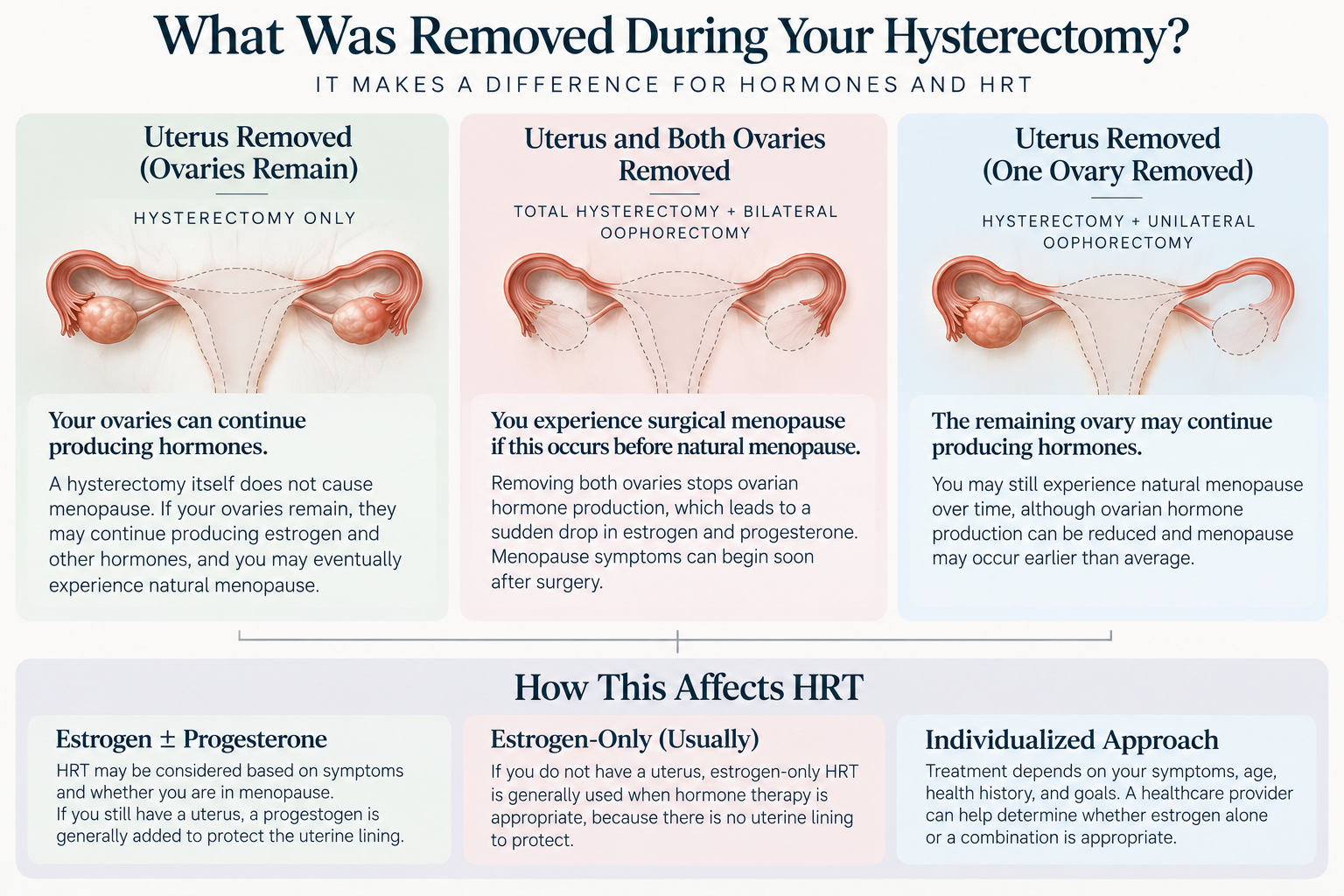
If your uterus was removed but your ovaries were left in place, your ovaries can continue producing hormones.
According to the Menopause Society, a hysterectomy itself does not cause menopause. Removing both ovaries before natural menopause, however, causes surgical menopause.
What Happens If You Had a Hysterectomy but Kept Your Ovaries?
If your ovaries remain, they may continue producing estrogen and other hormones even though you no longer have menstrual periods.
This creates an unusual situation:
You can no longer use your period as a marker of where you are in the menopause transition.
You may eventually begin experiencing symptoms such as:
- Hot flashes
- Night sweats
- Sleep changes
- Vaginal dryness
- Changes in sexual function
- Mood changes
- Other symptoms associated with the menopause transition
Those symptoms can still occur even though you have not had a menstrual period since your hysterectomy.
If symptoms become bothersome, a healthcare provider can evaluate whether menopause or another condition may be contributing and whether hormone therapy is appropriate.
What Happens If Your Ovaries Were Removed Too?
If both ovaries are removed before natural menopause, ovarian hormone production drops abruptly rather than gradually.
This is called surgical menopause.
The Menopause Society explains that removing both ovaries causes induced menopause. Symptoms may therefore begin soon after surgery.
Women who undergo surgical menopause can experience symptoms such as hot flashes, night sweats, sleep disruption, vaginal dryness, sexual concerns, and other effects of the sudden decline in ovarian hormones.
Recent research highlighted by the Menopause Society also suggests that some genitourinary symptoms may be more frequent or severe after surgical menopause than after natural menopause.
Hormone therapy may be considered depending on why the ovaries were removed, the woman’s age, medical history, symptoms, and potential contraindications.
Do You Need Progesterone After a Hysterectomy?
Often, no.
One of progesterone’s major roles in conventional systemic menopause hormone therapy is protecting the endometrium—the lining of the uterus—from stimulation by estrogen.
If systemic estrogen is given to a woman who still has a uterus, a progestogen is generally added to reduce the risk of endometrial hyperplasia and endometrial cancer.
If the uterus has been completely removed, there is no endometrium to protect.
That is why estrogen-only hormone therapy is generally used after a total hysterectomy when systemic HRT is appropriate.
The FDA’s current hormone therapy guidance states that systemic estrogen-alone therapy is usually used in women who have had their uterus removed.
Are There Situations Where Progesterone May Still Be Considered?
Yes. Medicine rarely fits perfectly into a one-sentence rule.
The exact type of hysterectomy matters, as can other aspects of a woman’s surgical and medical history.
For example, some women have had procedures in which uterine or endometrial tissue may remain. A history of conditions such as endometriosis can also make the hormone-therapy discussion more individualized.
This is why it is useful for your provider to know exactly which surgery you had rather than simply documenting “history of hysterectomy.”
If you are unsure, your operative report or previous medical records can help clarify whether the uterus, cervix, one ovary, both ovaries, and fallopian tubes were removed.
Can You Take Estrogen After a Hysterectomy?
Yes, if estrogen therapy is appropriate based on your symptoms and health history.
Systemic estrogen is available in several forms, including:
- Transdermal patches
- Gels
- Sprays
- Oral medications
- Certain systemic vaginal rings
The route can matter because oral and transdermal estrogen are processed differently by the body.
For example, oral estrogen passes through the liver before entering systemic circulation, while transdermal estrogen is absorbed through the skin.
We compare those two common approaches in Estrogen Patch vs. Pill: What’s the Difference?
What Symptoms Can HRT Treat After a Hysterectomy?
Having had a hysterectomy does not fundamentally change the symptoms for which systemic estrogen may be considered.
Hormone therapy is the most effective treatment for bothersome vasomotor symptoms such as:
- Hot flashes
- Night sweats
Systemic hormone therapy can also have other benefits, including helping prevent bone loss in appropriate patients.
Women experiencing primarily vaginal or urinary menopause symptoms may not necessarily need systemic estrogen.
Low-dose vaginal estrogen can be used to treat symptoms associated with genitourinary syndrome of menopause, including vaginal dryness and painful sex, when appropriate.
Do You Automatically Need HRT After a Hysterectomy?
No.
A hysterectomy by itself is not a reason to prescribe hormone therapy.
If your ovaries remain and are functioning normally, you may not need hormone therapy at all.
Even after natural menopause, not every woman needs HRT. Treatment is generally considered based on symptoms, age, health history, bone-health considerations, risks, and personal preferences.
The goal is not simply to “replace hormones” because a certain age has been reached.
The goal is to determine whether hormone therapy has a meaningful clinical purpose for the individual woman.
What If You Had Your Ovaries Removed Before Natural Menopause?
This situation deserves particular attention.
Removing both ovaries before natural menopause causes a sudden loss of ovarian function.
That is different from the gradual hormonal transition that usually occurs during perimenopause.
Women experiencing surgical menopause may have more abrupt symptoms, and younger women also have more years ahead of them without the ovarian hormone exposure they otherwise would have had.
For that reason, the benefits and risks of hormone therapy after premenopausal removal of both ovaries should be discussed with a healthcare provider rather than assuming that the same approach used for natural menopause applies.
The reason the ovaries were removed matters too. A history of certain hormone-sensitive cancers, for example, can significantly change treatment decisions.
What If You Don’t Know Whether Your Ovaries Were Removed?
This happens more often than you might expect.
Someone may remember being told that she had a “complete hysterectomy” years ago without knowing exactly which organs were removed.
Rather than guessing, your provider may be able to review:
- Your operative report
- Pathology records
- Previous gynecology records
- Your subsequent medical history
Knowing what surgery you actually had can make the menopause evaluation much clearer.
How Do You Know If You’re in Menopause After a Hysterectomy?
This can be less straightforward if your uterus was removed but your ovaries remain.
Normally, menstrual changes provide useful information about the menopause transition. After hysterectomy, that clue is gone.
A healthcare provider may instead consider your:
- Age
- Symptoms
- Surgical history
- Whether one or both ovaries remain
- Medical history
- Other possible explanations for your symptoms
Hormone testing can sometimes provide useful information, but a single hormone level does not always provide a simple yes-or-no answer.
We explain why in Do You Need Blood Tests for HRT?
Is HRT Safe After a Hysterectomy?
Hysterectomy status is only one part of determining whether hormone therapy is appropriate.
Your provider still needs to consider factors such as:
- Age and time since menopause
- Personal and family medical history
- History of blood clots
- Cardiovascular history
- Breast and other hormone-sensitive cancers
- Liver disease
- Unexplained bleeding
- The type, dose, and route of hormone therapy being considered
The Menopause Society emphasizes that hormone therapy decisions should balance individual benefits and risks rather than applying one rule to every woman.
Importantly, women without a uterus who can use estrogen alone have a different hormone-therapy risk profile from women who need estrogen plus a progestogen.
For a broader discussion, see Is Hormone Replacement Therapy Safe? Understanding the Risks and Benefits of HRT.
Didn’t the FDA Change Its HRT Warnings Recently?
Yes.
In February 2026, the FDA approved labeling changes for menopausal hormone therapy products, including removal of certain cardiovascular disease, breast cancer, and probable dementia language from boxed warnings on affected products.
The FDA did not remove the endometrial-cancer boxed warning from systemic estrogen-alone products.
That distinction is particularly relevant to understanding why the presence or absence of a uterus matters when selecting hormone therapy.
The labeling changes do not mean HRT is risk-free or appropriate for everyone. They reinforce the importance of discussing the benefits and risks of the specific treatment being considered for the individual patient.
Does HRT After Hysterectomy Have to Be a Pill?
No.
Estrogen therapy comes in multiple forms, and the route should be selected based on the woman’s health history, symptoms, risks, preferences, and treatment goals.
Options can include patches, pills, gels, sprays, vaginal treatments, and other formulations depending on what is being treated.
There is no single delivery method that is best for every woman.
Our guide to the different types of hormone replacement therapy explains these options in more detail.
Frequently Asked Questions
Can I take estrogen if I’ve had a hysterectomy?
Yes. If systemic hormone therapy is appropriate, estrogen-only therapy is generally used after a total hysterectomy because there is no uterine lining that requires protection with a progestogen.
Do I need progesterone if I don’t have a uterus?
Usually not for the purpose of protecting the uterine lining. Certain surgical histories or medical conditions can make the situation more individualized, so your complete history still matters.
Does a hysterectomy cause menopause?
Not necessarily. Removing the uterus ends menstrual periods and the ability to carry a pregnancy, but if the ovaries remain, they can continue producing hormones. Removing both ovaries before natural menopause causes surgical menopause.
How do I know if I’m in menopause if I had a hysterectomy?
Because you no longer have menstrual periods to follow, your provider may rely more heavily on your age, symptoms, ovarian status, medical history, and other clinical information. Laboratory testing may be useful in selected situations.
Can I start HRT years after a hysterectomy?
The date of your hysterectomy does not by itself determine whether you can use HRT. Your current age, time since menopause, symptoms, health history, and individual risk factors are more important to the decision.
What if I had a hysterectomy and both ovaries removed?
Removal of both ovaries causes surgical menopause if it occurs before natural menopause. Hormone therapy may be considered depending on your age, symptoms, reason for surgery, health history, and whether you have contraindications.
What if I had a hysterectomy but kept one ovary?
A remaining ovary can continue producing hormones. Having one ovary does not automatically mean you need HRT, although symptoms and ovarian function can change over time.
After a Hysterectomy, the Details Matter
“I had a hysterectomy” does not tell the whole hormonal story.
Was only the uterus removed? Do you still have one or both ovaries? Were both ovaries removed before natural menopause? Are you experiencing hot flashes, night sweats, vaginal symptoms, or other concerns now?
Those details can substantially change the hormone-therapy conversation.
At Vital Glow Men’s & Women’s Health, we provide individualized women’s hormone replacement therapy in Columbia, SC for women in Columbia and throughout the surrounding Midlands.
Rather than assuming every woman needs the same hormones after hysterectomy, we look at your surgical history, current symptoms, health history, risks, and goals to determine which options make sense for you.
The right plan starts with a conversation, not pressure.
Explore Women’s Hormone Replacement Therapy at Vital Glow
Medically reviewed by Candace Danbury, MSN, APRN, FNP-BC.