Short answer: Hormone replacement therapy is not one medication or one treatment. Depending on your symptoms, health history, whether you have a uterus, preferences, and individual risks, hormone therapy may involve estrogen, progesterone, or a combination of hormones delivered through a patch, pill, gel, cream, vaginal treatment, or another route. That is an important distinction …


Short answer: Hormone replacement therapy is not one medication or one treatment. Depending on your symptoms, health history, whether you have a uterus, preferences, and individual risks, hormone therapy may involve estrogen, progesterone, or a combination of hormones delivered through a patch, pill, gel, cream, vaginal treatment, or another route.
That is an important distinction if you are researching HRT.
Asking whether “HRT” is right for you is a little like asking whether “blood pressure medicine” is right for you. The category contains different medications, doses, and methods of delivery that do not all have identical purposes or risks.
Understanding those differences can make a hormone consultation much less confusing.
If you are still trying to determine whether your symptoms may even be related to the menopause transition, start with our guide to signs that it may be worth discussing hormone replacement therapy.
What Hormones Are Used in HRT?
For menopause treatment, the two hormones you will hear about most often are estrogen and progesterone.
Estrogen
Estrogen is the primary hormone used to treat many symptoms associated with menopause.
Systemic estrogen travels through the bloodstream and can be delivered through methods such as pills, patches, gels, or sprays. It is particularly effective for bothersome hot flashes and night sweats and can also help prevent bone loss.
Estrogen can also be used locally in the vagina when vaginal or urinary symptoms are the primary concern.
Progesterone
If you still have your uterus and use systemic estrogen, you will generally also need adequate progesterone or another progestogen.
Why?
Estrogen stimulates the lining of the uterus. Using systemic estrogen without appropriate endometrial protection can increase the risk of endometrial cancer.
Progesterone or another progestogen helps protect the uterine lining.
Women who have had a hysterectomy generally do not need progesterone solely for this purpose.
That is one reason two women experiencing similar menopause symptoms may receive different prescriptions.
Systemic HRT vs. Local Hormone Therapy
Before comparing patches with pills or creams, there is an even more important distinction:
Does the treatment need to affect the whole body, or primarily vaginal and urinary tissues?
Systemic hormone therapy
Systemic hormones enter the bloodstream at levels intended to affect tissues throughout the body.
They are commonly considered when women have symptoms such as:
- Hot flashes
- Night sweats
- Menopause-related sleep disruption
- Multiple bothersome systemic menopause symptoms
Systemic estrogen can be delivered in several ways, including pills, patches, gels, and sprays.
Local vaginal hormone therapy
Some women primarily experience vaginal dryness, irritation, discomfort with sex, or urinary symptoms associated with the genitourinary syndrome of menopause.
In these situations, low-dose vaginal estrogen may sometimes be used instead of systemic HRT.
Vaginal estrogen is available in forms such as creams, tablets, inserts, and rings. Unlike systemic treatment, low-dose vaginal therapy produces very little circulating estrogen and is designed primarily to treat tissues in and around the vagina and urinary tract.
This means a woman experiencing vaginal dryness does not necessarily need the same treatment as a woman whose primary concern is severe hot flashes.
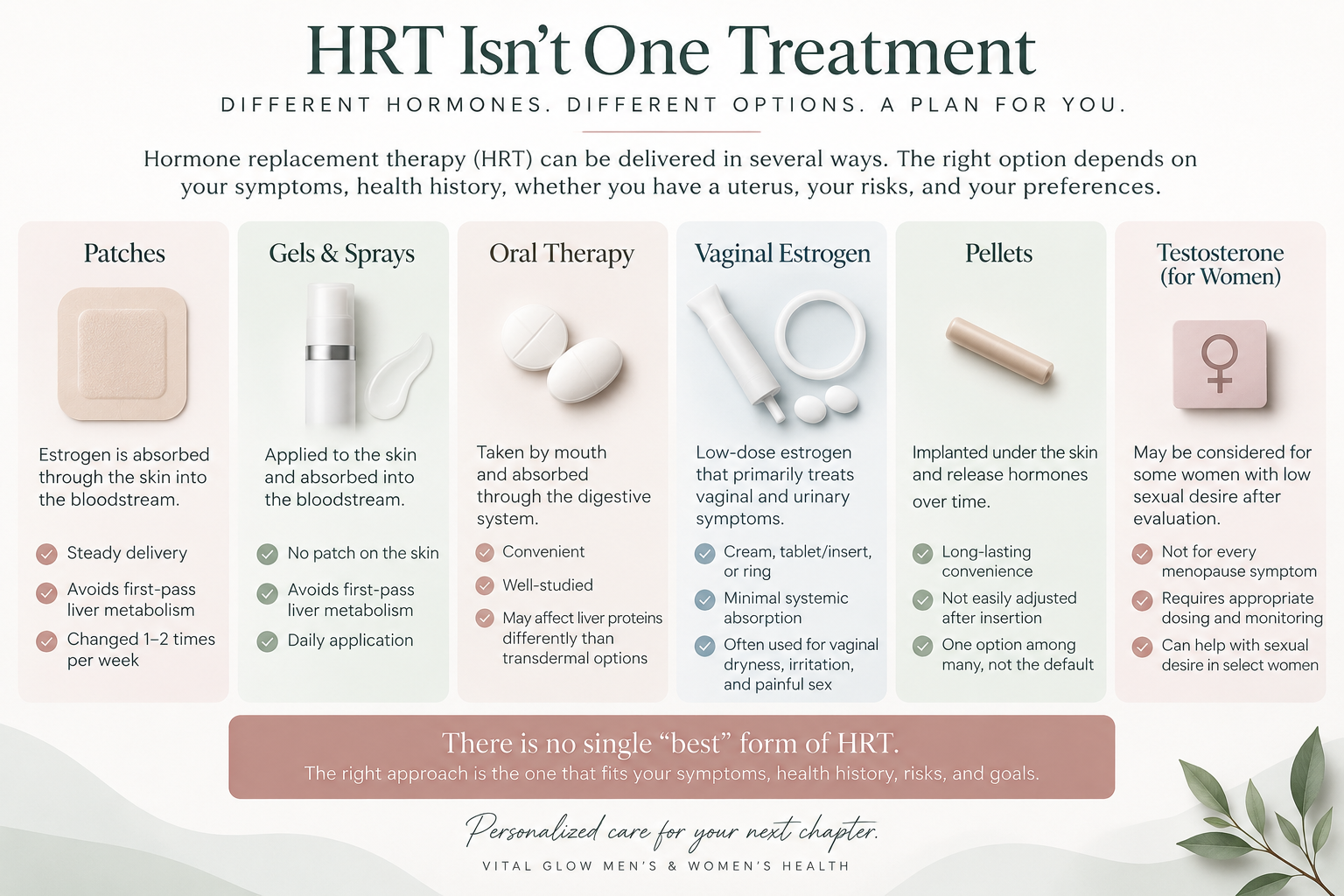
Hormone therapy can involve different hormones, doses, and delivery methods. The right approach depends on the symptoms being treated, your health history, individual risks, and your preferences.
Estrogen Patches
An estrogen patch is placed on the skin and delivers estrogen through the skin into the bloodstream.
Patches have become a common systemic HRT option because they avoid the digestive tract and first-pass metabolism through the liver.
That difference can matter.
Oral estrogen is associated with an increased risk of blood clots. Current menopause guidance indicates that this risk may be lower with transdermal estrogen delivered through the skin, such as a patch, gel, or spray.
Patches also provide ongoing delivery rather than requiring a daily estrogen pill.
But a patch is not automatically the best option for everyone. Skin sensitivity, adherence, cost, preference, medical history, and other factors can affect the decision.
Estrogen Gels and Sprays
Transdermal estrogen does not have to come from a patch.
Estrogen can also be applied to the skin as a gel or spray and absorbed into the bloodstream.
Like a patch, these methods bypass the digestive system.
Some women prefer them because there is no patch attached to the skin. Others prefer the convenience of a patch.
The important distinction is less about which option sounds newest and more about choosing an effective dose and delivery method that fits the patient’s health history and lifestyle.
Oral Hormone Therapy
Hormone therapy can also be taken by mouth.
Oral estrogen is convenient and has been used for decades. Oral micronized progesterone is also commonly used when progesterone is needed as part of the treatment plan.
However, swallowing a hormone and absorbing one through the skin are not physiologically identical.
Because oral estrogen passes through the liver before reaching systemic circulation, it affects certain liver-produced proteins and clotting factors differently than transdermal estrogen.
For some women, that difference may influence which route a provider recommends.
Vaginal Estrogen
Vaginal estrogen deserves its own category because it is often confused with systemic HRT.
Low-dose vaginal estrogen is intended primarily to treat vaginal and urinary symptoms associated with menopause, including vaginal dryness and discomfort with sexual activity.
It can come as:
- Vaginal cream
- Vaginal tablets or inserts
- A vaginal ring
Because systemic absorption is very low with low-dose vaginal estrogen, its risk profile differs substantially from systemic estrogen.
A woman may even use vaginal therapy along with systemic treatment if systemic HRT does not adequately relieve vaginal symptoms.
What About Testosterone for Women?
Testosterone is another hormone that sometimes enters the HRT conversation, but it should not simply be treated as a routine component of menopause therapy.
Women naturally produce testosterone, and levels change with age.
Evidence supports carefully prescribed testosterone therapy for some women with hypoactive sexual desire disorder (HSDD) after appropriate evaluation. Testosterone is not an established general treatment for every symptom sometimes attributed to “low hormones,” such as fatigue, weight gain, or brain fog.
Treatment also requires appropriate dosing and monitoring because excessive testosterone exposure can cause effects such as acne and unwanted facial or body hair.
The decision to consider testosterone should therefore begin with the specific problem being treated—not simply a hormone level.
What About Hormone Pellets?
Hormone pellets are implanted under the skin and release hormones over an extended period.
Their convenience is easy to understand: once inserted, patients do not have to remember a daily pill or regularly apply a patch or gel.
But convenience is only one consideration.
Unlike a patch, pill, or gel, a pellet cannot simply be stopped or quickly adjusted after insertion. Hormone exposure continues while the pellet dissolves.
There is also an important distinction between FDA-approved hormone medications and custom-compounded hormone preparations.
The Menopause Society notes that custom-compounded hormones have not been demonstrated to be safer or more effective than FDA-approved bioidentical hormone products.
Pellets may be discussed at Vital Glow when appropriate, but they are one option rather than the default definition of HRT.
The route should follow the patient’s needs—not the other way around.
What Does “Bioidentical HRT” Actually Mean?
The term bioidentical creates a lot of confusion.
It does not necessarily mean “natural,” and it does not necessarily mean compounded.
Bioidentical hormones have the same molecular structure as hormones produced by the human body.
There are FDA-approved medications—including forms of estradiol and micronized progesterone—that fit that description.
Custom-compounded products can also contain bioidentical hormones, but “compounded” and “bioidentical” do not mean the same thing.
Most importantly, a product being described as bioidentical does not automatically make it safer, more effective, or more appropriate for you.
How Do You Choose the Right Type of HRT?
There is no universally best form of hormone replacement therapy.
Your provider may consider:
- Your primary symptoms
- Your age and menopause stage
- Whether you still have a uterus
- Your personal and family medical history
- Blood-clot and cardiovascular risk factors
- Breast and endometrial health
- Vaginal and urinary symptoms
- Other medications
- Convenience and lifestyle
- Your preferences
- Cost and access
- How you respond to treatment
Sometimes the first plan works very well.
Sometimes treatment needs to be adjusted.
Hormone therapy is not necessarily a prescription that is chosen once and then ignored indefinitely. Symptoms, risks, and health needs can change, which is why follow-up matters.
If you are wondering whether you are even at the right stage to begin discussing treatment, read Can You Start HRT During Perimenopause, or Do You Have to Wait Until Menopause?
Does HRT Require Hormone Testing?
Not every woman needs extensive hormone testing to choose an HRT option.
During perimenopause, hormone levels can fluctuate significantly. Symptoms, age, menstrual history, and health history often provide important information that a single hormone measurement cannot.
Testing can still be useful when the clinical situation calls for it—for example, when investigating other possible causes of symptoms or monitoring certain therapies.
At Vital Glow, testing is used as part of the overall clinical picture rather than treating one laboratory number as the entire diagnosis.
You can learn more about comprehensive lab testing at Vital Glow and how testing may help providers look beyond hormones when symptoms could have several possible causes.
Is One Type of HRT Safer Than Another?
The route and combination can affect risk.
For example, oral and transdermal estrogen do not have identical effects on blood-clot risk. Estrogen alone and estrogen combined with a progestogen also have different considerations.
Whether you have a uterus changes what treatment may be necessary.
And low-dose vaginal estrogen is fundamentally different from systemic estrogen exposure.
This is why asking simply “Is HRT safe?” leaves out an important part of the question.
The more useful question is:
“What are the potential benefits and risks of this particular hormone, at this dose, delivered this way, for me?”
We explore that question in more detail in Is Hormone Replacement Therapy Safe? Understanding the Risks and Benefits of HRT.
Frequently Asked Questions
Is an estrogen patch better than an estrogen pill?
Not universally. Both can effectively deliver systemic estrogen, but their routes differ. Transdermal estrogen avoids first-pass liver metabolism and may have a lower blood-clot risk than oral estrogen. Your health history and preferences help determine which option is more appropriate.
Do I need progesterone with estrogen?
If you have a uterus and use systemic estrogen, adequate progesterone or another progestogen is generally needed to protect the uterine lining. Women who have had a hysterectomy usually do not need it for that purpose.
Is vaginal estrogen the same as HRT?
Vaginal estrogen is a form of hormone therapy, but low-dose vaginal treatment primarily acts locally and results in much lower systemic exposure than systemic HRT.
Are bioidentical hormones FDA approved?
Some are. FDA-approved estradiol and micronized progesterone products are examples of hormones that are structurally identical to hormones produced by the body. “Bioidentical” does not automatically mean compounded.
Does Vital Glow offer hormone pellets?
Pellets may be considered when clinically appropriate, along with other hormone therapy options. Treatment is individualized rather than automatically placing every woman on the same delivery method.
HRT Should Be a Treatment Plan, Not a Product
You do not need to walk into your first hormone appointment knowing whether you want a patch, pill, cream, or pellet.
That is what the evaluation is for.
If you are experiencing symptoms that may be related to perimenopause or menopause, the first step is understanding what is changing and what you want treatment to accomplish.
From there, you and your provider can discuss which options make sense based on your symptoms, health history, risks, and preferences.
Vital Glow Men’s & Women’s Health provides personalized women’s hormone replacement therapy in Columbia, SC and serves women throughout Lexington, Irmo, Chapin, West Columbia, Lake Murray, and the surrounding Midlands.
Explore Women’s Hormone Replacement Therapy at Vital Glow
Medically reviewed by Candace Danbury, MSN, APRN, FNP-BC