Short answer: There is no single symptom—or lab result—that tells a woman she “needs” hormone replacement therapy. But if changes such as hot flashes, night sweats, disrupted sleep, vaginal dryness, painful sex, or other symptoms of the menopause transition are interfering with your quality of life, it may be worth talking with a healthcare provider …


Short answer: There is no single symptom—or lab result—that tells a woman she “needs” hormone replacement therapy. But if changes such as hot flashes, night sweats, disrupted sleep, vaginal dryness, painful sex, or other symptoms of the menopause transition are interfering with your quality of life, it may be worth talking with a healthcare provider about whether hormone therapy is appropriate for you.
For many women, the confusing part is that the changes do not all arrive at once.
You may still be having periods. You may not think of yourself as being in menopause. You may simply know that you are sleeping differently, feeling different, or experiencing symptoms you never had before.
And because fatigue, mood changes, trouble concentrating, weight changes, low libido, and poor sleep can have many different causes, the goal should not be to diagnose yourself with a hormone problem.
The goal is to recognize when something has changed enough that it deserves a closer look.
1. Hot Flashes or Night Sweats Are Disrupting Your Life
Hot flashes and night sweats—often called vasomotor symptoms—are among the symptoms most strongly associated with the menopause transition.
Some women experience an occasional warm feeling that is mostly annoying. Others wake repeatedly soaked in sweat, change clothes or bedding during the night, or find themselves suddenly overheating during work, conversations, or everyday activities.
The Menopause Society identifies hormone therapy as the most effective treatment for bothersome hot flashes and night sweats.
That does not mean every hot flash automatically calls for HRT. Severity, frequency, health history, age, other symptoms, and personal preference all matter.
But if hot flashes or night sweats are affecting your sleep, work, comfort, or quality of life, they are a good reason to start a conversation about women’s hormone replacement therapy.
2. Your Sleep Has Changed
Sleep problems during perimenopause and menopause can take several forms.
You may fall asleep normally but wake repeatedly. Night sweats may interrupt sleep. You may wake far earlier than you used to and struggle to fall back asleep.
And poor sleep creates its own chain reaction.
After weeks or months of interrupted sleep, it is easy to feel exhausted, irritable, unfocused, or simply unlike yourself.
Hormone therapy is not a sleeping pill, and insomnia can have many causes. But when sleep disruption occurs alongside hot flashes, night sweats, cycle changes, or other menopause-related symptoms, changing hormones may deserve consideration as part of the picture.
3. Vaginal Dryness, Burning, or Painful Sex Has Appeared
Hormone changes can affect much more than periods.
Declining estrogen can contribute to changes in vaginal and urinary tissues. Women may notice dryness, irritation, burning, discomfort during sex, or other symptoms involving vaginal and urinary health.
These symptoms are common, but many women hesitate to mention them.
They are also treatable.
The FDA includes vaginal dryness and pain with sexual activity among menopausal symptoms that hormone treatment may help relieve.
Importantly, treatment does not always mean taking systemic HRT throughout the body. Some women whose primary symptoms are vaginal or urinary may be candidates for local vaginal hormone treatment instead.
That distinction is one reason an individualized discussion matters.
4. Your Periods Are Changing—and Other Symptoms Are Appearing Too
You do not have to wait until your periods disappear completely before hormone-related symptoms can begin.
Perimenopause is the transition before menopause, and hormone levels can fluctuate during this time.
Cycles may become shorter, longer, heavier, lighter, or less predictable. At the same time, symptoms such as hot flashes, night sweats, sleep problems, vaginal dryness, or sexual concerns may begin.
If you are not sure where you are in the transition, our guide to perimenopause vs. menopause and changing hormone symptoms explains the difference.
And if you are already experiencing symptoms but still having periods, read Can You Start HRT During Perimenopause, or Do You Have to Wait Until Menopause?
The important point is that treatment decisions are not based simply on whether you have reached the technical definition of menopause.
They are based on your symptoms, stage of life, health history, risks, goals, and what is actually affecting your quality of life.
5. You Feel “Off,” but the Symptoms Do Not Fit Into One Neat Box
This is where hormone evaluation becomes more nuanced.
Women commonly seek care because of concerns such as:
- Persistent fatigue or low energy
- Brain fog or difficulty concentrating
- Mood changes or irritability
- Low libido
- Changes in weight or body composition
- Changes in sleep
- Feeling less like themselves
These symptoms are real—but they are also nonspecific.
Fatigue could be related to poor sleep, anemia, thyroid problems, nutrient deficiencies, medications, stress, depression, metabolic issues, or many other causes.
Brain fog does not automatically mean low estrogen.
Weight gain does not automatically mean you need HRT.
Low libido can involve hormones, medications, relationships, vaginal discomfort, stress, sleep, mental health, and other factors.
That is why a good hormone consultation should investigate rather than assume.
At Vital Glow, the question is not simply, “Which hormone can we prescribe?”
It is: “What changed, what could be contributing, and what approach makes sense for this particular woman?”
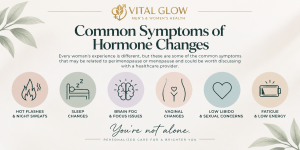
These symptoms can have many causes and don’t necessarily mean you need HRT. A personalized evaluation can help determine whether changing hormones may be contributing and which treatment options, if any, are appropriate.
Symptoms Alone Do Not Tell You Whether HRT Is Right for You
This is an important distinction.
A list of symptoms can tell you that it may be time to seek care. It cannot determine by itself whether hormone replacement therapy is appropriate.
Your provider may consider factors such as:
- Your age and stage of menopause
- Your menstrual history
- The symptoms that bother you most
- How strongly they affect daily life
- Your personal and family medical history
- Current medications
- Whether you have a uterus
- Previous blood clots, cardiovascular disease, certain cancers, liver disease, or unexplained bleeding
- Your preferences regarding treatment
- Whether another condition could be contributing
The benefits and risks of hormone therapy are not identical for every woman or every treatment.
We explore those differences in Is Hormone Replacement Therapy Safe? Understanding the Risks and Benefits of HRT.
For many healthy women with bothersome menopause symptoms, hormone therapy can be an appropriate option, particularly when started before age 60 or within about 10 years of menopause onset. Individual assessment still matters.
Do You Need Hormone Testing Before Starting HRT?
Not necessarily in the way many people expect.
During typical perimenopause and menopause, hormone levels can fluctuate considerably. A single hormone level does not always provide a clear answer about why you feel the way you do.
Your age, menstrual pattern, symptoms, medical history, and clinical evaluation can often be more informative than trying to identify a single “perfect” hormone number.
However, lab testing can still be useful when a provider needs to investigate overlapping causes, establish baseline health information, evaluate another suspected condition, or monitor certain treatments.
At Vital Glow, comprehensive lab testing may be used when it adds useful information rather than simply ordering the largest possible panel. Testing can help evaluate hormone, thyroid, metabolic, nutrient, blood-count, and other markers when appropriate.
What If Your Symptoms Are Real but HRT Is Not the Right Treatment?
Then the consultation still has value.
Hormone therapy is not appropriate for everyone, and not every midlife symptom is caused by menopause.
Sometimes the next step may be additional testing. Sometimes another medical issue deserves attention. Some women may benefit from nonhormonal treatment. Others may need local treatment rather than systemic hormone therapy.
A good consultation should leave room for all of those possibilities.
You should not have to walk into an appointment already convinced that you need pellets, a patch, a cream, an injection, or any other specific product. If hormone therapy is appropriate, there are several different hormones and delivery methods to consider. Learn more in our guide to the different types of hormone replacement therapy.
The treatment should follow the evaluation—not the other way around.
What HRT Options Does Vital Glow Offer?
Vital Glow provides personalized women’s hormone therapy in Columbia, SC for women experiencing perimenopause, menopause, postmenopause, and other hormone-related concerns.
Depending on your symptoms, health history, preferences, and provider recommendation, treatment may involve estrogen, progesterone, testosterone when appropriate, or other individualized approaches. Delivery options may include patches, creams, gels, oral medications, injections, pellets, vaginal hormone options, or nonhormonal support when appropriate.
There is no single “Vital Glow HRT protocol” that every patient receives.
Your treatment should fit you.
When Is It Time to Make an Appointment?
You do not need to wait until your symptoms become unbearable.
Consider scheduling a conversation if:
- Hot flashes or night sweats are interfering with daily life.
- Sleep changes are becoming persistent.
- Vaginal dryness or painful sex is affecting your comfort or relationship.
- Your cycles are changing and new symptoms are appearing.
- You have several unexplained symptoms and want help sorting through them.
- You have questions about perimenopause or menopause that have never been clearly answered.
- You are wondering whether HRT could help but do not know whether it is safe or appropriate for you.
You also do not need to walk in saying, “I need HRT.”
You can simply say, “Something has changed, and I want to understand why.”
That is enough to begin.
Frequently Asked Questions
What are the strongest signs that I may benefit from HRT?
Bothersome hot flashes, night sweats, and certain vaginal or sexual symptoms are among the menopause-related concerns for which hormone therapy has the clearest established role. Other symptoms should be evaluated in context because they can have several causes.
Can I consider HRT if I am still getting my period?
Yes. Hormone therapy may be considered during perimenopause even while periods continue. Whether treatment is appropriate depends on your symptoms, health history, risks, and provider evaluation. You can learn more in our guide to starting HRT during perimenopause.
Does fatigue mean my hormones are low?
Not necessarily. Fatigue can result from sleep disruption, thyroid problems, anemia, nutrient deficiencies, medications, stress, metabolic conditions, and many other factors. Hormones may be part of the picture, but fatigue alone does not diagnose a hormone deficiency.
Will hormone testing tell me whether I need HRT?
Not by itself. Particularly during perimenopause, hormone levels can fluctuate. Symptoms, menstrual history, age, health history, clinical evaluation, and testing when appropriate all help inform treatment decisions.
Is HRT safe?
HRT can be appropriate for many women, but it is not right for everyone. The type of hormone, route of administration, age, timing, medical history, and individual risk factors all affect the risk-benefit discussion. Read our full guide to HRT risks and benefits.
Better Hormone Care Starts With Understanding What Changed
You do not have to diagnose yourself.
And you do not have to accept feeling miserable simply because someone told you that your symptoms are “just part of getting older.”
If something has changed—your sleep, comfort, periods, hot flashes, sexual health, or simply how you feel day to day—it is reasonable to ask why.
Vital Glow Men’s & Women’s Health provides private, provider-led hormone care in Columbia, SC for women throughout Irmo, Lexington, Chapin, Lake Murray, West Columbia, and the surrounding Midlands.
Your first appointment is a conversation about what has changed, what may be contributing, and what options make sense for you.
Explore Women’s Hormone Replacement Therapy at Vital Glow
Medically reviewed by Candace Danbury, MSN, APRN, FNP-BC