Skin rejuvenation may help with sun damage, texture, pores, dullness, pigmentation, collagen loss, and maintenance with personalized treatment planning.


“Skin rejuvenation” can mean many different things. A treatment that helps uneven pigmentation may not be the best treatment for enlarged pores, acne scars, fine lines, redness, or skin laxity.
That is why choosing a skin treatment should usually begin with the concern you want to improve—not the name of a device or procedure.
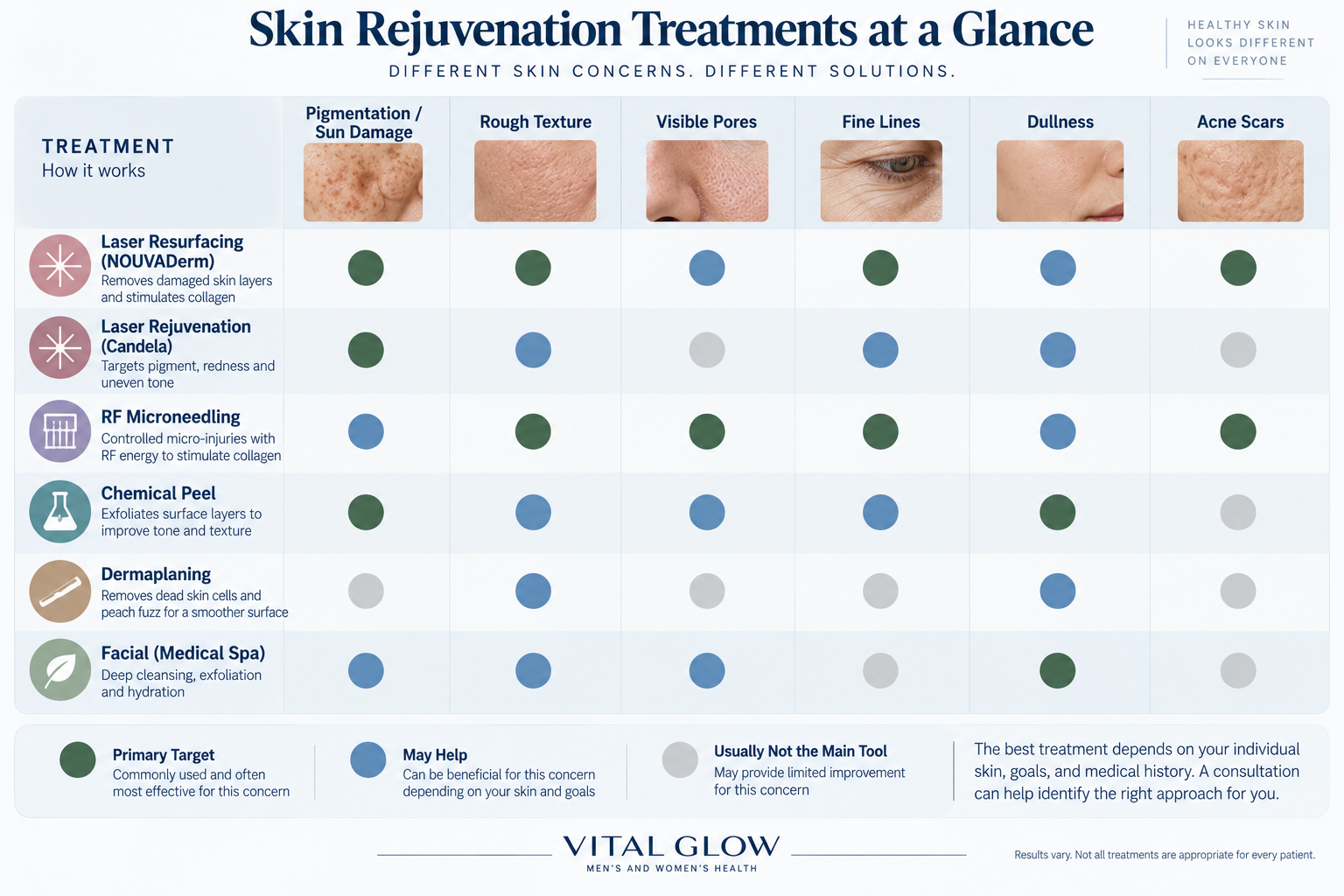
At Vital Glow, skin rejuvenation options include treatments such as laser resurfacing, laser-based skin treatments, RF microneedling, PRP, chemical peels, dermaplaning, and facials. Each works differently, reaches different layers of the skin, and may be better suited to certain goals.
What Does Skin Rejuvenation Mean?
Skin rejuvenation is a broad term for treatments intended to improve the appearance or quality of the skin.
Depending on the treatment, the goal may be to address:
- Sun damage and uneven pigmentation
- Rough or uneven texture
- Visible pores
- Fine lines
- Acne scars
- Dullness
- Redness or visible vessels
- Changes in firmness or collagen support
Those concerns do not all come from the same process, which is why there is no single “best” skin rejuvenation treatment.
Start With the Skin Concern, Not the Treatment
It is easy to hear about a laser, peel, microneedling treatment, or facial and ask whether that procedure is “good for skin.”
A better question is:
What exactly are we trying to change?
For example, brown spots caused by accumulated sun exposure involve pigment. Rough texture involves the surface and structure of the skin. Acne scars may extend deeper into the dermis. Visible vessels involve blood vessels. Skin laxity involves structural changes that cannot necessarily be corrected by improving the surface.
Different targets may therefore require different approaches.
What Causes Sun-Damaged Skin?
Ultraviolet radiation from the sun damages skin over time.
This accumulated damage can contribute to:
- Brown spots and uneven pigmentation
- Blotchy skin tone
- Fine lines and wrinkles
- Rough texture
- Loss of elasticity
- Visible blood vessels or persistent redness
Sun damage is cumulative, so changes may become more noticeable years after the exposure that contributed to them.
Treatments can improve some visible signs of photodamage, but they do not make the skin immune to future UV damage.
Daily sun protection therefore remains an important part of maintaining results.
Which Treatments Can Help Sun Spots and Uneven Pigmentation?
The best approach depends on what is causing the discoloration.
Options used for selected pigmentation concerns can include laser-based treatments and chemical peels.
Certain laser wavelengths can target pigment within the skin, while chemical peels use controlled chemical exfoliation to remove selected layers of damaged surface skin.
The American Academy of Dermatology lists laser resurfacing and chemical peels among treatments dermatologists may use for signs of sun damage such as age spots and uneven skin tone.
However, not every brown spot should automatically be treated cosmetically.
A new, changing, irregular, bleeding, or otherwise concerning pigmented lesion should be medically evaluated rather than simply treated as a sun spot.
What Is Laser Skin Rejuvenation?
“Laser treatment” is not one single procedure.
Different devices use different wavelengths and treatment settings to interact with specific targets in the skin.
Depending on the device and indication, laser-based treatment may be used to address concerns involving:
- Pigmentation
- Sun damage
- Redness or visible vessels
- Texture
- Fine lines
- Collagen remodeling
This is why the name of the laser alone does not tell you whether it is appropriate for your concern.
The wavelength, treatment depth, settings, skin type, and intended target all matter.
What Is Laser Resurfacing?
Laser resurfacing uses controlled laser energy to improve selected characteristics of the skin.
Depending on the technology and treatment settings, resurfacing may be used for concerns such as:
- Uneven texture
- Fine lines
- Sun-damaged skin
- Selected acne scars
- Overall skin quality
Vital Glow uses NOUVADerm technology as one option for laser resurfacing.
Resurfacing treatments intentionally create a controlled response in the skin, so redness, sensitivity, peeling, or other temporary changes may occur during recovery depending on treatment intensity.
What Is RF Microneedling?
RF microneedling combines microneedles with radiofrequency energy.
The needles enter the skin at controlled depths while RF energy produces controlled heating within targeted tissue.
This differs from traditional microneedling, which creates controlled micro-injuries with needles but does not add radiofrequency energy.
RF microneedling may be considered for concerns involving skin texture, wrinkles, selected acne scars, and firmness depending on the device and patient.
Because RF adds thermal energy beneath the skin, it also has risks that traditional microneedling does not have.
The FDA has reported serious complications with certain uses of RF microneedling, including burns, scarring, fat loss, disfigurement, and nerve damage. RF microneedling should therefore be treated as a medical procedure and performed by an appropriately trained licensed healthcare provider.
Learn more about RF microneedling vs. traditional microneedling →
Can Microneedling Help Enlarged Pores?
Pores are normal structures in the skin and cannot literally be removed.
However, their appearance can become more noticeable because of oil production, skin texture, loss of surrounding support, or other factors.
Procedures that improve overall skin texture and collagen remodeling may make pores appear less prominent in some patients.
The realistic goal is therefore usually to reduce the appearance of pores, not permanently eliminate them.
What Can Chemical Peels Improve?
Chemical peels use a chemical solution to create controlled exfoliation at a selected depth.
Depending on the type and strength of the peel, they may be used to improve concerns such as:
- Dull complexion
- Uneven pigmentation
- Sun-damaged skin
- Rough texture
- Selected fine lines
- Certain types of acne
Peels vary considerably in depth and recovery.
A superficial peel may involve relatively limited downtime, while deeper peels create a more significant injury and require substantially more healing.
The appropriate peel depends on the skin concern, skin type, treatment depth, and desired amount of downtime.
What Does Dermaplaning Do?
Dermaplaning is a surface-level exfoliation treatment that removes superficial dead skin cells and fine vellus hair.
It can leave the skin feeling smoother and may temporarily improve the appearance of dull or rough surface texture.
Dermaplaning does not reach the deeper layers targeted by treatments such as RF microneedling or laser resurfacing.
That distinction is important.
If the primary concern is deep acne scarring, significant pigmentation, or structural skin changes, surface exfoliation alone may not address the underlying issue.
What Can a Facial Actually Improve?
Facials can play a useful role in skin maintenance, hydration, cleansing, exfoliation, and addressing selected surface concerns.
They can be particularly appropriate when the goal is:
- Hydration
- Temporary improvement in dullness
- Surface exfoliation
- Skin maintenance
- A smoother or refreshed appearance
But a facial should not be expected to produce the same structural changes as a resurfacing laser or energy-based procedure.
That does not make one treatment “better” than another. They simply operate at different levels and serve different purposes.
What Role Can PRP Play in Skin Rejuvenation?
Platelet-rich plasma, or PRP, is prepared from a patient’s own blood.
After the blood is collected, it is processed to concentrate platelet-rich plasma for use in selected treatments.
PRP is used in aesthetic medicine in several ways, including approaches intended to support skin quality and tissue remodeling.
Evidence and treatment protocols vary depending on exactly how PRP is being used, so it should not be presented as a universal solution for every skin concern.
The treatment method, indication, and expected benefit should be clear before proceeding.
Which Treatment Is Best for Dull Skin?
Dullness is a description rather than a diagnosis.
Skin may appear dull because of:
- Surface buildup
- Dryness or dehydration
- Uneven pigmentation
- Rough texture
- Sun damage
- Changes in skin turnover
If the issue is primarily superficial, a facial, dermaplaning, or selected peel may be reasonable.
If dullness is actually the result of significant pigmentation or textural damage, a different treatment may be more appropriate.
Which Treatment Is Best for Rough Skin Texture?
Again, the cause and severity matter.
Very superficial roughness may respond to exfoliation or a peel.
More established texture changes may lead to consideration of treatments that produce greater remodeling, such as laser resurfacing or microneedling-based procedures.
Acne scars are another category entirely because scar type and depth influence treatment selection.
What About Fine Lines and Wrinkles?
Not every wrinkle has the same cause.
Some lines primarily develop from repeated muscle movement. Others are related more to sun damage, skin quality, collagen changes, volume loss, or a combination of factors.
That distinction changes treatment.
For example, a movement-related line may respond better to a wrinkle relaxer, while fine surface lines associated with skin quality may lead to consideration of resurfacing or collagen-remodeling treatments.
Trying to treat every wrinkle with the same procedure can therefore produce disappointing results.
Can Skin Rejuvenation Tighten Loose Skin?
Some treatments can produce modest changes in skin firmness through collagen remodeling.
However, non-surgical skin rejuvenation has limits.
Improving texture or collagen quality is not the same as removing significant excess skin.
The degree of laxity, treatment area, age, skin quality, and desired result all influence whether a non-surgical treatment is likely to meet someone’s expectations.
Can One Treatment Address Several Skin Concerns?
Sometimes.
A resurfacing treatment, for example, may influence both texture and fine lines. A peel may improve both dullness and selected pigmentation.
But trying to make one procedure solve every concern can lead to poor treatment selection.
Some patients benefit from a staged plan in which different treatments address different targets.
Others may only need one simple treatment because they have one primary concern.
More treatments do not automatically mean better skin.
How Much Downtime Should You Expect?
Downtime varies substantially among skin rejuvenation procedures.
A maintenance facial or dermaplaning session may involve little interruption to normal activities.
A peel may cause redness or peeling depending on its depth.
Microneedling and RF microneedling can cause temporary redness, swelling, sensitivity, or other effects.
Laser resurfacing can involve a more noticeable recovery period depending on treatment intensity.
This is why downtime should be part of treatment selection—not an afterthought.
A treatment is not appropriate for you if its expected recovery does not fit your schedule or comfort level, even if it could technically address the skin concern.
Does Skin Tone Affect Treatment Choice?
Yes.
Skin tone can influence the risks and appropriate settings for lasers, peels, and other procedures.
In particular, procedures that affect pigment or create inflammation can produce unwanted hyperpigmentation or hypopigmentation in some patients.
The device, wavelength, treatment depth, settings, and provider’s experience with different skin types all matter.
This is another reason treatment should be individualized rather than selected solely from a menu.
Why Is Sun Protection Important After Skin Rejuvenation?
Many rejuvenation treatments temporarily make the skin more sensitive while it heals.
UV exposure can also continue creating the same photodamage that treatment is intended to improve.
Sun protection therefore serves two purposes:
- Helping protect healing skin after treatment
- Reducing additional UV damage that can undermine long-term results
Daily broad-spectrum sunscreen and appropriate sun-protective behavior remain important even after successful treatment.
How Do You Choose the Right Skin Rejuvenation Treatment?
A useful treatment plan starts by identifying:
- Your primary concern — pigment, texture, pores, scars, redness, fine lines, laxity, or dullness.
- How deep the problem is — surface-level, within the skin, vascular, pigment-related, or structural.
- Your skin type and medical history.
- How much downtime you are comfortable with.
- Your realistic treatment goal.
Only then does it make sense to choose the procedure.
This approach helps avoid the common mistake of choosing a treatment because it is popular and then trying to make your skin concern fit the device.
Skin Rejuvenation in Columbia, SC
Vital Glow offers personalized skin rejuvenation in Columbia, South Carolina, for patients from Irmo, Lexington, Chapin, Lake Murray, West Columbia, and surrounding Midlands communities.
Available options include NOUVADerm laser resurfacing, Candela laser treatments, RF microneedling, PRP, chemical peels, dermaplaning, facials, and other individualized aesthetic treatments.
The appropriate choice depends on what you actually want to improve.
Rather than assuming every patient needs the same procedure, treatment can be selected based on your skin concern, skin type, goals, medical history, desired downtime, and realistic expectations.
Explore skin rejuvenation options at Vital Glow →
Frequently Asked Questions About Skin Rejuvenation
What is the best treatment for sun-damaged skin?
There is no single best treatment for all sun damage. The appropriate option depends on whether the main concern is brown spots, uneven tone, redness, fine lines, texture, or another change. Laser treatments, resurfacing, and chemical peels can address different aspects of photodamage.
What is the best treatment for large pores?
Pores cannot be permanently removed. Treatments that improve skin texture and collagen support may reduce their appearance in selected patients. The appropriate approach depends on why the pores appear prominent and what other skin concerns are present.
What treatment is best for dull skin?
If dullness is primarily superficial, options such as facials, dermaplaning, or selected chemical peels may help. If pigmentation or deeper textural damage is responsible, laser or other rejuvenation treatments may be more appropriate.
Is RF microneedling better than laser resurfacing?
Neither is universally better. RF microneedling and laser resurfacing work differently and have different indications, risks, recovery profiles, and treatment targets. The better choice depends on the concern being treated and the individual patient.
Can skin rejuvenation remove acne scars?
Some procedures can improve the appearance of selected acne scars, but scar type and depth matter. Complete removal cannot be guaranteed, and some patients require a combination or series of treatments.
How many skin rejuvenation treatments will I need?
That depends on the treatment, skin concern, severity, desired result, and individual response. Some procedures are performed as a series, while others may be used less frequently. An appropriate plan should be based on the treatment goal rather than a predetermined number of sessions.
Can I combine different skin treatments?
Sometimes, but treatments should be combined or sequenced intentionally. Different procedures create different levels of inflammation and healing, so timing and compatibility matter.
How do I know which treatment I need?
Start by identifying your primary concern and having the skin evaluated. The treatment should then be selected based on the target, skin type, medical history, desired downtime, and realistic expectations—not simply because a particular procedure is popular.
Medically reviewed by Candace Danbury, MSN, APRN, FNP-BC.
Gregg D. <gdanbury@gmail.com>