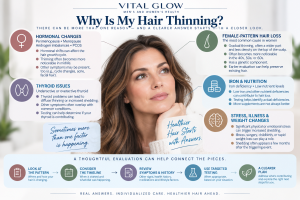
Women’s hair thinning may involve hormones, iron, thyroid, stress, postpartum changes, menopause, nutrition, and scalp health.


Hair thinning in women is common, but the reason is not always obvious. Hormonal changes, hereditary female-pattern hair loss, thyroid disease, iron or other nutritional deficiencies, significant stress, illness, medications, and scalp conditions can all contribute—and sometimes more than one factor is involved.
This is especially confusing in midlife, when changes in hair can occur around the same time as perimenopause or menopause.
It can be tempting to assume that changing hormones explain everything. But thinning hair is a symptom, and understanding the pattern, timing, health history, and other symptoms can help determine what may actually be contributing.
What Does Hair Thinning Look Like in Women?
Women do not all experience hair loss in the same way.
You might notice:
- A widening part
- A thinner ponytail
- More scalp becoming visible through the hair
- Gradual thinning across the top of the scalp
- More hair than usual in the shower, brush, or on your clothing
- Thinning around the temples or hairline
- Distinct patches of missing hair
- Changes in the eyebrows or other body hair
The pattern matters because different types of hair loss can look and behave differently.
What Is Female-Pattern Hair Loss?
Female-pattern hair loss is the most common cause of hair loss in women.
It is a hereditary, progressive form of hair loss. Instead of developing the same pattern of baldness commonly seen in men, women often notice that their part gradually becomes wider and the hair across the top of the scalp becomes less dense.
The American Academy of Dermatology notes that female-pattern hair loss frequently begins in a woman’s 40s, 50s, or 60s, although it can start earlier.
Because it is progressive, recognizing it earlier can matter. Treatment generally has a better chance of preserving existing hair when started before substantial thinning has occurred.
Can Perimenopause and Menopause Cause Hair Thinning?
Hair changes frequently become noticeable during the same years that women experience perimenopause and menopause.
Hormones may play a role in female-pattern hair loss, and the condition becomes more common after menopause.
But that does not mean every woman who develops thinning hair during perimenopause has hair loss solely because her estrogen level changed.
Midlife can also bring changes in thyroid function, nutrition, medications, weight, stress, sleep, and health conditions that can affect the hair.
The timing is therefore useful information, but it does not establish the cause by itself.
Learn more about women’s hormone care at Vital Glow →
Can Low Estrogen Cause Hair Loss?
Hair follicles are influenced by hormones, and hormonal changes may affect the hair-growth cycle.
However, hair thinning during the menopausal transition is more complicated than simply diagnosing “low estrogen.”
Female-pattern hair loss has an important genetic component, and other medical or nutritional factors can produce similar symptoms.
For that reason, a hormone value should not be interpreted in isolation as proof that it explains the hair loss.
What About Testosterone and Androgens?
Androgens are hormones that include testosterone and related hormones.
Some women have conditions associated with androgen excess, such as polycystic ovary syndrome (PCOS), which can be associated with scalp hair thinning as well as symptoms such as acne or increased facial and body hair.
But women can also develop female-pattern hair loss without having an obvious androgen abnormality on laboratory testing.
Whether hormone testing is appropriate depends on the pattern of hair loss, other symptoms, health history, menstrual history, medications, and clinical assessment.
Can Thyroid Problems Cause Hair Thinning?
Yes.
Thyroid disease can affect the hair-growth cycle and may contribute to diffuse thinning or increased shedding.
Other symptoms can sometimes provide additional clues, but thyroid symptoms overlap with many other conditions.
If your history or symptoms raise concern for thyroid dysfunction, thyroid testing may be appropriate.
Treating an underlying thyroid disorder can allow hair affected by the condition to recover, although regrowth takes time.
Can Low Iron Cause Hair Loss?
Iron deficiency can contribute to hair loss.
That does not mean every woman with thinning hair should automatically take an iron supplement.
If iron deficiency is suspected, laboratory testing can help determine whether it is actually present.
This distinction matters because taking excess iron when you do not need it can cause harm.
The same principle applies to many supplements marketed for hair growth: identify a deficiency before assuming supplementation is the solution.
Does Biotin Help Women’s Hair Grow?
Biotin is heavily marketed for hair, skin, and nails, but taking extra biotin does not automatically improve thinning hair.
If someone has a true biotin deficiency, correcting the deficiency is appropriate.
For people who are not deficient, evidence that additional biotin improves hair growth is limited.
High-dose biotin can also interfere with certain laboratory tests, which is another reason to tell your healthcare provider about supplements you take.
Can Dieting or Weight Loss Cause Hair Shedding?
Yes.
Significant weight loss, inadequate calorie intake, insufficient protein, and nutritional deficiencies can contribute to increased hair shedding.
This can be particularly relevant for women who have recently lost a substantial amount of weight.
Hair shedding does not necessarily mean the weight loss itself was unhealthy, but rapid changes in weight, nutrition, illness, or other physical stressors can affect the hair-growth cycle.
If you are undergoing medical weight management and notice substantial shedding, mention it to your provider rather than simply adding a hair supplement.
Can Stress Make Your Hair Fall Out?
Yes. Significant physical or emotional stress can trigger excessive hair shedding known as telogen effluvium.
The frustrating part is that the timing may not seem obvious.
Excessive shedding often becomes noticeable a few months after the triggering event.
Potential triggers can include:
- Major illness or high fever
- Surgery
- Childbirth
- Significant weight loss
- Major emotional stress
- Changes in certain medications or hormones
The American Academy of Dermatology notes that this type of excessive shedding often improves as the body readjusts after the stressor resolves.
Hair Shedding vs. Hair Loss: What’s the Difference?
It is normal to shed hair every day.
The American Academy of Dermatology estimates that losing approximately 50 to 100 hairs per day is normal.
Telogen effluvium occurs when significantly more hairs than usual enter the shedding phase.
Female-pattern hair loss is different. It involves progressive miniaturization of hair follicles, producing gradually thinner and shorter hairs.
A woman can also experience both conditions at the same time.
For example, someone with early female-pattern hair loss may experience a period of substantial shedding after an illness or major weight change, making previously subtle thinning suddenly much more noticeable.
Can Medications Cause Hair Loss?
Yes. Hair loss or excessive shedding can occur in association with certain medications.
If thinning began after starting, stopping, or changing a medication, that timing is worth discussing with your healthcare provider.
Do not stop a prescribed medication on your own because you suspect it is affecting your hair.
Your provider can help determine whether the medication could plausibly be contributing and whether alternatives should be considered.
Why Does Scalp Health Matter?
Not all hair loss begins with hormones or nutrition.
The scalp itself should be considered.
Symptoms such as:
-
- Persistent itching
- Scaling
- Redness
- Burning or tenderness
- Pustules or drainage
- Areas that appear smooth or scarred
can suggest a scalp condition that deserves evaluation.
Some inflammatory and scarring forms of hair loss can permanently damage hair follicles. Those conditions require appropriate diagnosis and should not simply be treated as cosmetic thinning.
What Blood Tests Can Be Helpful for Women’s Hair Loss?
There is no universal “female hair-loss panel” that every woman needs.
Testing should be guided by your symptoms, medical history, diet, medications, menstrual history, pattern of hair loss, and examination.
Depending on those findings, appropriate testing may include evaluation for issues such as:
- Iron deficiency
- Thyroid dysfunction
- Selected nutritional deficiencies
- Hormonal abnormalities when symptoms suggest them
- Other medical conditions suggested by your history
The goal is not to order the largest possible panel. It is to use laboratory testing to answer a clinical question.
Learn more about comprehensive laboratory testing at Vital Glow →
What If All My Labs Are Normal?
Normal laboratory results do not mean that your hair thinning is imaginary or that nothing can be done.
Many forms of hair loss—including female-pattern hair loss—are diagnosed primarily through history and examination rather than through an abnormal blood test.
Laboratory testing is useful for identifying or excluding selected contributors. It is not a test that determines whether hair loss itself is real.
If thinning persists despite normal laboratory results, the pattern and scalp findings become especially important.
What Treatments Are Available for Female-Pattern Hair Loss?
Treatment depends on the diagnosis.
For female-pattern hair loss, topical minoxidil is an established treatment and is FDA approved for women.
Other prescription medications may be considered by an appropriate clinician for selected women, although some are used off-label for female-pattern hair loss and have important pregnancy and medical considerations.
Additional options may include low-level laser devices, procedural treatments, or hair transplantation in appropriate candidates.
No treatment works for everyone, and most hair-growth treatments require time and continued use to maintain their benefit.
What About PRP for Women’s Hair Loss?
Platelet-rich plasma, or PRP, is another treatment being studied and used for certain types of hair loss.
PRP is prepared from the patient’s own blood and injected into targeted areas of the scalp.
Early research involving female-pattern hair loss has been promising, but the American Academy of Dermatology notes that additional research is still needed to establish its safety and effectiveness for this condition.
That means PRP should not be presented as a guaranteed treatment for every woman with thinning hair.
Whether it is reasonable to consider depends on the likely cause of hair loss, degree of thinning, scalp health, treatment history, and individual goals.
Learn more about hair restoration at Vital Glow →
When Should You See a Dermatologist for Hair Loss?
Some patterns deserve dermatologic evaluation rather than proceeding directly to a cosmetic hair-restoration treatment.
Consider seeing a dermatologist if you have:
- Sudden or rapidly worsening hair loss
- Distinct bald patches
- Scalp pain, significant itching, inflammation, or scaling
- Possible scarring
- Loss of eyebrows, eyelashes, or other body hair
- Hair loss accompanied by other unexplained symptoms
- An unclear diagnosis
- Hair loss that is progressing despite treatment
Dermatologists specialize in disorders of the hair and scalp and can perform additional testing, including scalp biopsy when necessary.
Women’s Hair Thinning Evaluation in Columbia, SC
At Vital Glow, we approach women’s hair thinning by looking at more than the hair itself.
Depending on your situation, that may include discussing the pattern and timing of hair loss, menstrual and hormonal changes, weight changes, nutrition, medications, stressors, other symptoms, scalp health, and whether targeted laboratory testing may be useful.
When appropriate, hair-restoration options can then be considered as part of an individualized plan.
The objective is not to automatically blame hormones, recommend supplements, or sell a procedure. It is to better understand what may be contributing to your hair changes before deciding what to do about them.
Frequently Asked Questions About Women’s Hair Thinning
Why is my hair getting thinner as I get older?
Female-pattern hair loss becomes more common in midlife and after menopause, but aging and hormonal changes are not the only possibilities. Thyroid disease, nutritional deficiencies, medications, stress-related shedding, scalp disorders, and other factors can also contribute.
Does menopause cause hair loss?
Hair thinning commonly becomes more noticeable around menopause, and hormonal changes may contribute to female-pattern hair loss. However, thinning during menopause should not automatically be attributed to estrogen without considering other possible causes.
Can low iron cause thinning hair?
Yes. Iron deficiency can contribute to hair loss. Testing can help determine whether deficiency is actually present before beginning iron supplementation.
Can thyroid problems make your hair fall out?
Yes. Thyroid disease can cause thinning or increased shedding. Treating the underlying thyroid disorder may allow affected hair to recover over time.
Can stress cause hair loss months later?
Yes. Telogen effluvium can cause noticeable shedding several months after a significant physical or emotional stressor, which is why the connection is sometimes difficult to recognize.
Why is my part getting wider?
A gradually widening part is a common sign of female-pattern hair loss. Other causes can produce similar thinning, so an evaluation can help distinguish among them.
Should I take biotin for thinning hair?
Not automatically. Biotin supplementation is most appropriate when a deficiency exists. Taking additional biotin without deficiency has not been shown to solve most causes of hair thinning and can interfere with some laboratory tests.
Can I have hair loss even if my blood work is normal?
Yes. Female-pattern hair loss and several other forms of alopecia do not require an abnormal blood test for diagnosis. Laboratory testing is used when there is reason to investigate specific contributing conditions.
Medically reviewed by Candace Danbury, MSN, APRN, FNP-BC.