Compare Botox and Xeomin wrinkle relaxers and learn how Vital Glow plans natural-looking treatment for forehead lines, frown lines, and crow’s feet.


Botox® and Xeomin® are both injectable botulinum toxin type A products used to temporarily soften facial lines caused by repeated muscle movement. Although “Botox” is often used conversationally to describe the entire category, Botox is actually a specific brand—and it is not the only wrinkle relaxer available.
At Vital Glow, we use Xeomin® (incobotulinumtoxinA) for cosmetic wrinkle-relaxer treatments.
If you’re comparing Botox vs. Xeomin before your first appointment, the most useful questions aren’t simply which brand is “better.” It helps to understand how wrinkle relaxers work, what Xeomin is, what areas can be treated, what results realistically look like, and why the injector’s assessment and technique matter.
What Is a Wrinkle Relaxer?
Wrinkle relaxers are injectable medications that temporarily reduce activity in selected muscles.
Many facial lines become more noticeable because the same muscles repeatedly contract when you frown, squint, smile, or raise your eyebrows.
By temporarily reducing activity in carefully selected muscles, a botulinum toxin treatment can soften the appearance of these movement-related lines.
The American Academy of Dermatology explains that botulinum toxin is injected into targeted facial muscles to temporarily relax them, reducing the appearance of certain lines and wrinkles.
Is Botox the Same Thing as a Wrinkle Relaxer?
Botox is a wrinkle relaxer, but “Botox” is not the generic name for every wrinkle-relaxing injectable.
Botox Cosmetic® is one brand of botulinum toxin type A. Xeomin® is another.
Other botulinum toxin products are also available in the United States.
This is similar to situations where one well-known brand name becomes commonly used to describe an entire product category. In casual conversation, someone may say they “get Botox” even when they are actually receiving a different botulinum toxin product.
If the specific product matters to you, ask your provider what is actually being injected.
What Is Xeomin?
Xeomin is the brand name for incobotulinumtoxinA, a prescription botulinum toxin type A medication.
For cosmetic use in adults, current FDA labeling includes temporary improvement in the appearance of:
- Moderate to severe glabellar lines—the vertical “frown lines” between the eyebrows
- Moderate to severe horizontal forehead lines
- Moderate to severe lateral canthal lines—commonly called crow’s feet
Xeomin also has FDA-approved medical indications unrelated to cosmetic wrinkle treatment.
At Vital Glow, Xeomin is the wrinkle relaxer we use for cosmetic treatments.
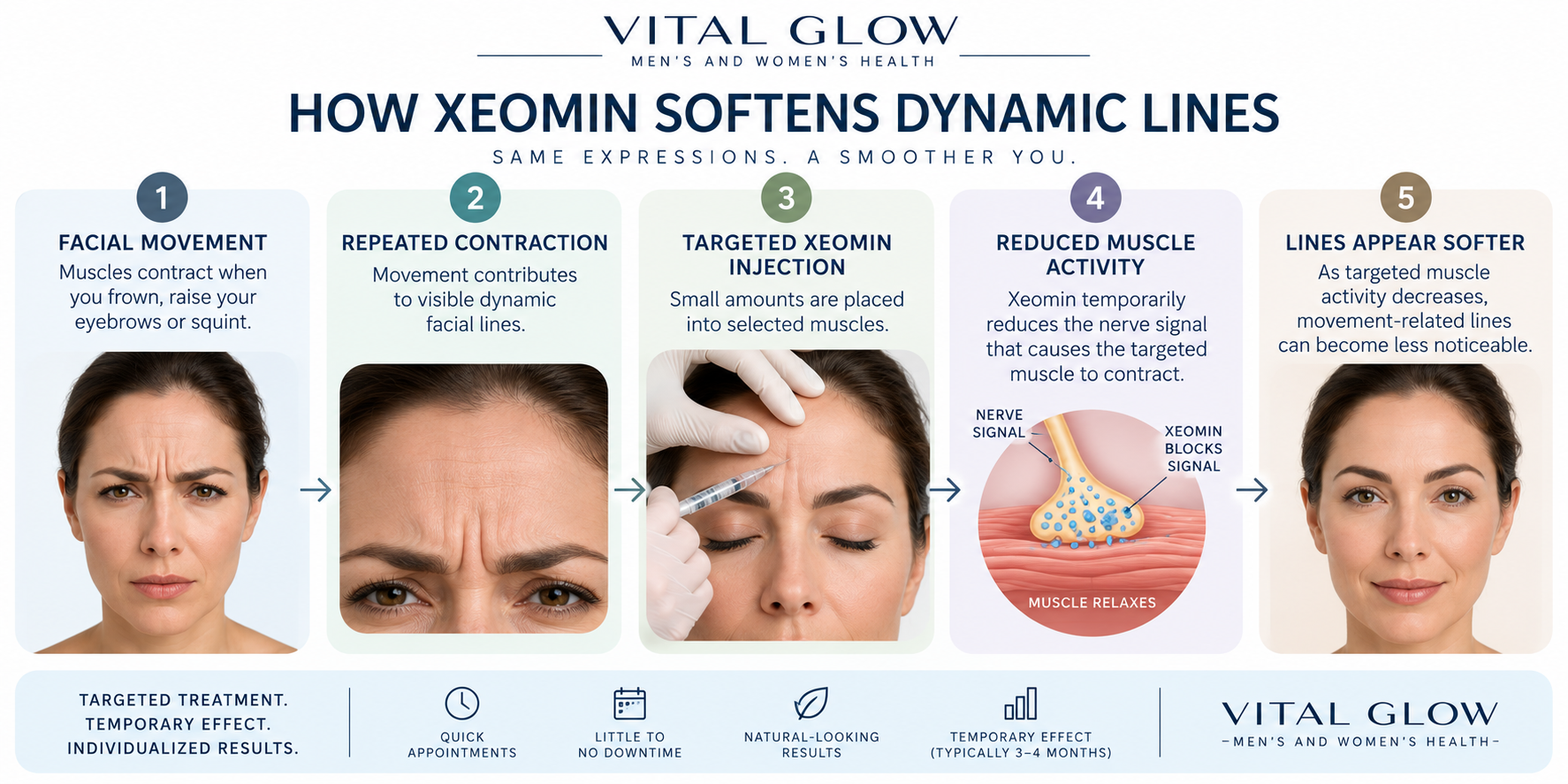
Xeomin temporarily reduces activity in targeted facial muscles, allowing movement-related lines to appear softer while preserving an individualized, natural-looking result.
Botox vs. Xeomin: What Is the Difference?
Both Botox Cosmetic and Xeomin contain botulinum toxin type A, but they are different prescription products with different formulations and manufacturer-specific dosing.
One frequently discussed difference is formulation. Xeomin contains incobotulinumtoxinA without certain accessory proteins found in some other botulinum toxin preparations.
That difference is real, but it should not automatically be translated into claims that one product is universally safer, more effective, “cleaner,” or better for every patient.
Another important distinction is that units of Xeomin should not simply be converted into units of another botulinum toxin product. FDA prescribing information states that Xeomin’s potency units are specific to the product and are not interchangeable with other botulinum toxin preparations.
For a patient, the more useful question is whether the selected product, treatment areas, dose, and injection plan are appropriate for the result you’re trying to achieve.
Does Xeomin Work Differently From Botox?
Both products ultimately reduce muscle activity by interfering with the release of acetylcholine, a chemical involved in signaling muscles to contract.
For cosmetic treatment, the result is temporary relaxation of selected facial muscles.
That can make movement-related lines appear softer while the medication is active.
Neither product permanently freezes a muscle, and neither permanently removes wrinkles.
Will Xeomin Make My Face Look Frozen?
It does not have to.
The goal of cosmetic wrinkle-relaxer treatment is not necessarily to eliminate every bit of facial movement.
A treatment plan can be designed to soften selected lines while preserving expression, depending on your anatomy, goals, dose, and treatment areas.
The American Academy of Dermatology notes that natural-looking treatment involves relaxing targeted muscles without unnecessarily affecting surrounding muscles.
This is one reason injector technique matters as much as the name printed on the vial.
What Areas Can Xeomin Treat?
Current FDA labeling for cosmetic Xeomin treatment in adults includes upper facial lines involving:
- Frown lines between the eyebrows
- Horizontal forehead lines
- Crow’s feet around the outer eyes
Botulinum toxin products are also sometimes used by qualified medical professionals in other facial areas based on individual anatomy and treatment goals. Some of those uses may be outside the product’s FDA-approved cosmetic indications.
If a provider recommends treating another area, it is reasonable to ask what the treatment is intended to accomplish and whether that use is FDA-approved or off-label.
How Quickly Does Xeomin Work?
Wrinkle relaxers do not produce their full cosmetic effect immediately after injection.
Changes develop as the medication begins reducing activity in the targeted muscles.
The American Academy of Dermatology notes that many patients begin seeing results from botulinum toxin treatment within several days.
Your final result should be evaluated after the treatment has had sufficient time to take effect rather than judging it immediately after leaving the office.
How Long Does Xeomin Last?
Results are temporary.
The duration varies from person to person and can be influenced by the treatment area, dose, individual response, muscle activity, and other factors.
The American Academy of Dermatology reports that cosmetic botulinum toxin effects commonly last approximately three to four months, although individual results vary.
Xeomin’s FDA labeling specifies that cosmetic retreatment should occur no more frequently than every three months.
What Happens During a Xeomin Appointment?
Your appointment should begin with an assessment rather than automatically repeating a predetermined number of injections.
Your provider may evaluate:
- The lines that concern you
- Your facial anatomy
- How your muscles move when you make different expressions
- Your desired amount of movement after treatment
- Previous wrinkle-relaxer treatments and results
- Relevant health history
- Medications and supplements
Once a treatment plan is established, small amounts of Xeomin are injected into selected muscles.
The injections themselves are generally brief, and most people can return to ordinary activities soon afterward.
Does Xeomin Require Downtime?
Most patients do not require traditional recovery time after cosmetic botulinum toxin injections.
Temporary redness, swelling, tenderness, or bruising can occur around injection sites.
The American Academy of Dermatology states that most patients return to everyday activities immediately after botulinum toxin treatment.
You should follow the specific aftercare instructions provided by your injector.
What Are the Possible Side Effects of Xeomin?
Like any prescription medication or medical procedure, Xeomin can cause side effects.
For upper facial-line treatment, FDA prescribing information reports injection-site bruising among observed adverse reactions.
Botulinum toxin treatment more broadly can also result in temporary effects such as:
- Redness
- Swelling
- Soreness
- Bruising
- Headache
- Temporary weakness of a nearby muscle
- Temporary eyelid or eyebrow drooping
Botulinum toxin products, including Xeomin, also carry an FDA boxed warning about the potential for toxin effects to spread beyond the injection site. Serious symptoms such as problems swallowing or breathing require immediate medical attention.
Serious complications from cosmetic use are uncommon, but understanding potential risks is part of informed treatment.
Who Should Not Receive Xeomin?
Xeomin is not appropriate for everyone.
FDA prescribing information lists contraindications including known hypersensitivity to botulinum neurotoxin type A or Xeomin’s ingredients and infection at a proposed injection site.
Your injector should know about relevant medical conditions, medications, supplements, previous botulinum toxin treatments, allergies, pregnancy or plans for pregnancy, and other information that could affect treatment.
Can You Be Allergic or Resistant to Wrinkle Relaxers?
Individual responses to botulinum toxin treatment can vary.
True treatment failure should not automatically be assumed simply because someone’s result differs from a previous treatment or from another patient’s experience.
Dose, injection placement, muscle anatomy, treatment expectations, timing, and the specific product used can all affect the apparent result.
If you have had an unexpected response to a previous wrinkle relaxer, discuss exactly what happened with your injector before another treatment.
Is Xeomin “Cleaner” Than Botox?
You may see Xeomin marketed online as a “cleaner” or “purer” form of botulinum toxin because of differences in its formulation.
Those terms can be misleading.
Xeomin does have a different formulation and lacks certain accessory proteins present in some other botulinum toxin preparations. But “clean” is not a medical measure of whether an injectable is safer, healthier, or more appropriate for a particular patient.
A more useful comparison focuses on approved uses, formulation, clinical evidence, your treatment goals, and the provider’s experience with the product.
Is Xeomin Better Than Botox?
There is no useful universal answer that applies to every patient.
Both are established prescription botulinum toxin products used for cosmetic treatment.
Vital Glow uses Xeomin, but that does not require claiming that every person everywhere should choose Xeomin over every other wrinkle relaxer.
The result also depends on more than the brand.
Facial anatomy, dose, injection placement, treatment goals, and provider technique all influence the outcome.
Why Does the Injector Matter?
Botulinum toxin injections may appear simple, but effective cosmetic treatment requires an understanding of facial anatomy and muscle movement.
A few millimeters can matter when selecting injection locations.
The goal is to affect the intended muscle while minimizing unwanted effects on nearby muscles.
The American Academy of Dermatology emphasizes the importance of provider training and experience when considering botulinum toxin treatment.
Before treatment, you should feel comfortable asking who will perform the injections, what product will be used, what result is realistic, and what risks are relevant to you.
What Should I Ask Before My First Wrinkle Relaxer Treatment?
Useful questions include:
- What product are you using?
- Who will perform my injections?
- What areas do you recommend treating and why?
- What amount of movement should I expect afterward?
- When should I expect to see results?
- How long might the result last?
- What side effects should I expect?
- What symptoms should prompt me to contact the practice?
- What should I do or avoid after treatment?
- When would another treatment be appropriate?
A good consultation should help you understand the treatment rather than simply sell you a certain number of units.
Xeomin Wrinkle Relaxer Treatments in Columbia, SC
Vital Glow offers Xeomin wrinkle-relaxer treatments for adults in Columbia and surrounding Midlands communities.
Treatment begins by discussing the areas that concern you, evaluating your facial movement and anatomy, and determining whether Xeomin is appropriate for your goals.
Our approach is focused on individualized treatment rather than automatically using the same injection pattern or dose for every patient.
Learn more about Xeomin wrinkle relaxer treatments at Vital Glow →
Frequently Asked Questions About Botox and Xeomin
Are Botox and Xeomin the same thing?
No. Botox Cosmetic and Xeomin are different prescription botulinum toxin type A products. They work through a similar mechanism but have different formulations and product-specific dosing.
Does Vital Glow offer Botox?
No. Vital Glow uses Xeomin for cosmetic wrinkle-relaxer treatments.
What is Xeomin used for cosmetically?
Current FDA labeling includes temporary improvement of moderate to severe frown lines between the eyebrows, horizontal forehead lines, and crow’s feet in adults.
How long does Xeomin last?
Botulinum toxin results commonly last around three to four months, although individual results vary. Treatment area, dose, muscle activity, and individual response can influence duration.
Will Xeomin completely freeze my face?
Not necessarily. Treatment can be planned to soften selected muscle activity while preserving natural facial expression. The result depends on anatomy, dose, injection placement, and treatment goals.
Is Xeomin better than Botox?
There is no single wrinkle relaxer that is necessarily best for every patient. Both are established botulinum toxin products. Product selection, appropriate dosing, injection technique, facial anatomy, and individual goals all contribute to the outcome.
Is Xeomin FDA approved?
Yes. Xeomin is FDA approved for several medical indications and for temporary improvement of certain upper facial lines in adults, including glabellar lines, horizontal forehead lines, and lateral canthal lines.
Is there downtime after Xeomin?
Most patients can return to normal daily activities after treatment. Temporary redness, tenderness, swelling, or bruising can occur at injection sites. Follow the aftercare instructions provided by your injector.
Medically reviewed by Candace Danbury, MSN, APRN, FNP-BC.